books showsmedialinkscontact

Wednesday, July 7, 2010

Running Away to the Western Wall (and knocking over movie stars)

Leaving Jerusalem, we passed the corner of Raz's house. I wanted to jump out and run there, to pop in for a second and stay there forever. Sometimes Israel makes you so sure of things. It's crazy to say this about Rabbi Raz, who's about the least straight-Haredi person ever, but it makes you think how good an ultra-Orthodox lifestyle must be.

So. I'm in Israel.
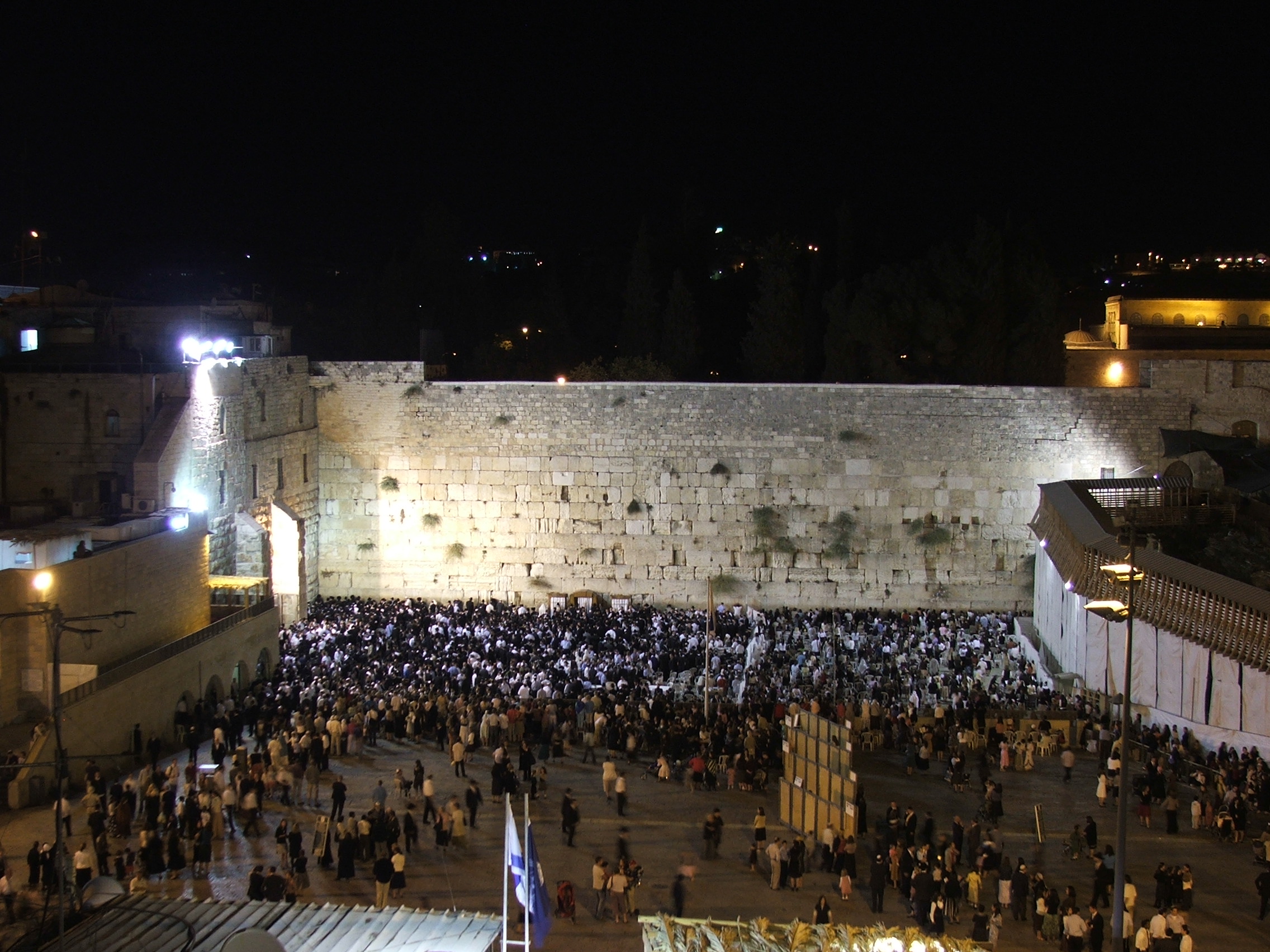


We'd just had our two free hours in Jerusalem, virtually the only free time on this whole manic 5-day, 20 hour-a-day conference they call ROI 120. There was a reception with wine and hors d'oeuvres and former Prime Minister Ehud Olmert, who I'd thought was in jail, but, hey, good for him that he's not. (And, yeah, sorry I don't know anything about politics.) Kobi Oz, who's an Israeli rock star, showed up for a surprise performance. But (a) it's the Three Weeks, when we're not supposed to listen to music, and (b) it was, as I said, our only 2 hours to do something, so I left my seat and ran.

I turned inside, to the amazing Israeli animation pavilion that the event was being held outside. Everything about the pavilion's architecture reminded me of the Disney studios in the 1950s, which they always used to show you at the beginning of the Disney Sunday Movie, the Place Where Magic Happened. Hey, that could be all of Israel. Inside the lobby the only other Orthodox person was hiding out, a refugee from the music. He grinned at me, a companion in his zealotry. And I hated to tell him -- but I wasn't a refugee. I was a runaway.

I ran outside. I ran down the hill to Jerusalem, the real Jerusalem where cars drove like they didn't believe in pedestrians and restaurants seduced you with neon lights and pictures of melted cheese over basically everything. I stopped at my sister-in-law's house, who I haven't seen in a year. Who just had a baby, and even though they're total first-time parents and are paranoid about opening the door on a sleeping baby, let me see him. He was breathing so radically. His chest rising and falling, half his body mass growing. I stayed for ten minutes, trying not to let my anxiety kick my ass, just talking to them. And eating pizza.

And then I ran to the Kotel.

I don't know why going to the Western Wall has occupied this spot in my life. The one thing I need to do in Israel, and the one thing I always try to squeeze into 3 minutes of time. Most of the time involves running to and from it -- just going through the Old City is a 20-minute trek each way -- even if, as I did, you cut through the Arab Shuk and coast along the stones and almost break your neck. And then you get there, and you throw yourself against the wall and say Shema, you say Psalms, you grab for any script you can, any arrangement of words that's already been written for you, because there's nothing you can say of your own that packs in quite enough pain and/or power. And you cry, without really knowing 100% why, maybe because you've built the experience up in your head or maybe you realize that all of the problems in your life, and all the incompleteness you feel, is all because you're waiting for the Messiah to come and heal it all and bring back your dead best friend and stop worrying about your kids quite so much.

Or maybe it's the Wall itself. The promise that hasn't been fulfilled yet, so it could be basically promising anything.

I finished praying. Ran back the long way, through the main streets of the Old City, hoping I'd bump into someone. Didn't. Grabbed a cab back, used my last 20 shekels, because I was late, and why would I change money when I could make a crazy zero-time dash to the Kotel instead?

I ended up returning to the party before the buses showed. Figured I had time to run to the makolet (translation: bodega, or, for you real English-speakers, a mini-mart) in the corner and grab some kosher Doritos for the family. Bumped into Matt Bar on the corner, who ran with me. He dashed into the store. While I swiveled on the front step, because this guy had just walked out and was in the process of bumping into me, and he was six and a half feet tall in a white shirt with tzitzis hanging on top of it and I had to pick my jaw up off the floor, because the last time I'd seen him had been on a movie screen, and he looked more like this:


I asked if he was Shuli Rand. He nodded guiltily with a smile. I told him I loved him. I think he understood how I meant it. Matt Bar took the opportunity to shove my book at him (which he'd had in his hand) and told him I wrote it, which I think showed him that I wasn't a crazed fan, or, at least, I wasn't just a crazed fan. He apologized for not being able to read English well. I told him I'd send him a copy if we ever got it translated. And I told him I'd just finished my first movie, and I hoped it was going to make the world a better place like his, and not just screw things up more.

He pulled me out to his car, which was tiny and black and old and totally awesome. It was a total fulfillment of his prophecy in Ushpizin, the movie he wrote & starred in, that even if he did get all that miracle money, he wouldn't spend it on something stupid like a fancy car. And his wife -- His wife! The all-time Adi Ran lip-synching champion of the world!* -- pulled out his new CD. Because he wanted to give me his address, and that was the most convenient way to write to him.

So now I've got an assignment. Remind me, please, if you get a chance. And, yes, by the time Matt and I got back, the buses still hadn't left. So we were safe.

_____
* -- you'll know what I'm talking about if you see the movie. So see it. Really.

Friday, July 2, 2010

Out of Office, But Still into You

Hey! So by the time you're reading this, I'm going to be far, far away, running to Israel for this odd Young Jewish Innovators convention. If you miss talking to me, TeensReadToo just posted a pretty lengthy interview with me about Losers, Neil Gaiman, the ZZ Top/Hasidic Jewish episode of The Simpsons, and a bunch of other stuff. And A Wrinkle in Time comes up for the fourth time this week. Here's a cool deleted-scenes type moment from Losers:

You have the chance to go back and change a scene from one of your previous releases. What book would you choose, what scene would you change, and how would you alter it?

There's one scene in LOSERS about a girl Jupiter likes, and how they both wind up in a very random and very suddenly emotional place, and he winds up discovering her eating disorder...and then something big happens. I totally understand why we took it out -- it was too much of an unexpected turn in the book, and it didn't really fit with everything else that was happening to Jupiter -- but I still think it's a great scene, and it still fits into the Jupiter chronology. It's been getting under my skin, how a 14-year-old guy deals with dating someone who has an eating disorder, and I think it might be growing into its own book.
keep reading > 

Thursday, June 24, 2010

Nirvana's "Polly" Live (the cover version)

The slammin' Melissa Broder hosts the Polestar Poetry series, and she just tried something new*: picking an album (in this case Nirvana's Nevermind, and having a team of poets (in this case, us) write poems about it, one poet per song.

I got in early, which meant that I got one of the first picks. I chose "Polly," the song about sexual assault and boys who think they control the world. Don't ask me why.


I didn't plan it this way, but the story I'm telling -- and especially Christian -- all ties in to my story in the anthology Punk Rock Saved My Ass, an incredible little collection to benefit 924 Gilman, one of the first punk collectives in Berkeley. It's only $10, and you should check it out. In order to get what I'm talking about in the video, though, check out the adrenaline-fueled piece Kat Georges did before me.

And then go check out the whole series.

Wednesday, June 23, 2010

Punk Torah Prayerbook

On MyJewishLearning, I interview Patrick Aleph and Michael Sabani about the Punk Torah Siddur that they wrote designed, and released. My favorite part:

Some of the prayers — especially the bedtime shema — are surprisingly peaceful for, well, someone who shouts for a living. How’d you swing that?

Patrick: That’s fair. I’m in a band where I scream and roll around on the floor, but there’s a place for meditation in every person’s life. This is the best example I can give of this: I was at Jewlicious, and I was working in the kitchen patrick aleph punktorahwith Sasha Edge and her father, who catered it — they’re screaming and there’s knives everywhere, and fire. But then when it was time for Shabbos, we ended up making motzi over a vegan cookie and drinking Kedem grape juice and some of the back-of-the-house volunteers had a great, awesome, totally spiritual and peaceful moment. If you’re a rambunctious person like myself, it’s even more important.

read the rest >

Wednesday, June 16, 2010

The Rebbe and the Forty-Nine Hipsters

Last week, I told you how the Biala Rebbe was coming to our house. And I've gotten a bunch of emails/Facebooks/twittery questions back, asking the question that should be self-evident: What did he say?


First, let me tell you what I think. I think the Rebbe sees things that the rest of us don't see. I don't know if he's hooked up to any otherworldly powers or has a direct line to G*d that the rest of us don't. But I do think that he's a professional at this sort of thing. The same way that, more than a normal person, a psychologist is going to watch me chewing on my cuticle and know that it probably relates to the fact that I'm always hungry -- I mean, of course they will, it's their job -- the Rebbe also picks up on stuff. Maybe it's tiny physical movements. Maybe it's our auras. I don't know.

My wife and I sat down with the Rebbe. Immediately, before he asked our names (he always asks our names), he turned to her and said: "You're loved from above, and you're loved below. Why are you always stressing out?"

Case in point. It's not like other people aren't stressed. It's not like 98% of the people there weren't stressed. But, in her case -- this week, and the certain circumstances in our lives and what was going on -- yeah, it was pretty freaking relevant. If I would've had to pick a single topic to talk about, it would be the amount of stress that we (and, specifically, she) are under.

So, go fig.

It was a really weird night. Awesome, but weird. I'd kind of figured that it would be a party of sorts, since the Rebbe sees people one at a time and a bunch of us were waiting -- but it wasn't that kind of atmosphere at all. We sat around. We made small talk. It wasn't fun small talk, though; it was the kind of small talk that you make while you're waiting for the results of a particularly invasive exam. Everyone was half in that room and half in their own heads, thinking about what they wanted to say. When a random man with whom you have no straight connection flies from Israel, and you can talk to him about anything, it's a horrible kind of freedom. What's the most important thing in your life? How do you sum that up? What do you ask for a blessing for -- your kids, your job, your books? Everything?

In cases, like ours, you don't even decide. The Rebbe just starts talking. He spoke Hebrew, which I mostly understood, but it helped to have it repeated back in English (by Rabbi Davide, my old teacher at yeshiva) a second time. He asks the questions, and you fill in the blanks. He asked why I spread myself so thin -- to which I could only say, yes. I told him about my new movie and I asked what I should be writing now -- another screenplay, a teen novel, a real novel, or what. He said, it doesn't matter. Just pick something, and go on it 100%. Don't divide myself up.

I think we got lucky -- or unlucky, depending on your vantage point. We were the second people to speak to the Rebbe, so I had the entire rest of the night to chew on what he said. Meanwhile, people in the living room were looking at me for answers, like I'd gotten out of there successfully, so what do they do? The people on their way out didn't look at me like that. They had their own mental stuff going on.

Two Israeli girls who went in there came out satisfied, like they'd gotten the exact thing they asked for. My one stodgy, rationalist friend came out a little shaken, like the Rebbe'd pulled one of his Jedi mind-reading tricks. The person who was the most excited to go in came out crying. It sounds like a collection of riddles, or stories whose answers I'll never know, but in the moment, it was amazing -- like watching one of those grainy family videos that you shouldn't have a right to see, but you do. It really wasn't about fortunetelling. It was about what you boil your life down to, when you've only got one thing to say.

Halfway through our session, the doors to the room slid open. Rabbi Davide stood up, ready to intercept whoever was interrupting. Then my two-year-old daughter, who'd gone to sleep hours ago and who never woke up, ran in through the crack. She wasn't crying or afraid or uneasy. She just ran up, held her arms out, and demanded, "Up." I scooped her up, plopped her on my lap, and introduced her to the Rebbe, and introduced the Rebbe to her right back. Sometimes you don't even need a Hasidic sage to tell you what the most important parts of your life are. Sometimes you just need a conduit.

photos by Dan Sieradski

The Movie Gets a Little Realer

Just wanted to share two quick items of movie awesomeness with you:

1) "1/20" has an IMDB page! (No, I'm not on it yet. But my title is! Really, though, it has the movie's tagline and the actors and all sorts of official information that I didn't know anyone was allowed to know. But the big thrill is that, dude, it's the Internet Movie Database. It's the Hollywood equivalent of seeing your name in print for the first time.)

2)And we also have a movie poster:


That mohawk in the poster belongs to Xiomara, the star of the  show. The director, the producer, and I were eating hummus on Ninth Avenue and this bubbly, cute, sane-looking girl strolled by. She was wearing a pink dress. Our producer leaped up and chased her down half a block, then dragged her back by one of her ponytails (she had two). "This is Ayako," he told us. "She's auditioning for Xiomara."

I didn't believe him. Then I saw her audition tape -- it was one of those tapes that you think might have been filmed at an asylum, where one minute she's sweet and docile and courteous, the next she's ranting and screaming and about to knock the camera out of the cameraman's hand -- and I was like, okay, this is working. Then she showed up for her haircut on the first day of filming -- I ran into her the next day in the dressing rooms, all spikes and leather jackets and hair that looked like it could pierce skin -- and she blew my mind. She wasn't that bubbly Ninth Avenue girl anymore. She was Xi.

Monday, June 14, 2010

Ethan Young and me fight over comics

Ethan Young, who does the fabulous online comic Tails, asked me to fill in for a while as he reaches the end of his first book. It's hard following a comic with a bunch of straight-up words, but we're talking about our comics obsession, so maybe that will help. Also, I ended up being a character in his comic, which (hopefully) lends my entries some DVD actors'-commentary credibility...


Anyway, go read it.
Maybe I’ve just been spoiled. Reading comics — especially reading someone like Neil Gaiman, or Alan Moore, who spend hours detailing the minutiae of how each panel looks. Yes, just mentioning their names is a cliché, but it’s obvious that they were both the kind of kids who read each page of a comic a hundred times as kids. They really appreciate the graphic design of a page; you can go over the panels and margins of, say, ‘League of Extraordinary Gentlemen’ and find something new each time.

That’s what I want my books to be like. The ones I write, the ones I read, the ones I buy. I know my prose-books won’t get that way until I start self-publishing, or until I get really big — Scholastic doesn’t let their mid-range authors anywhere NEAR the design computers — but a boy can dream.

And, in the meantime, I’ve still got my comics to read. And my omnibus Sandman to obsess over.

more >

Thursday, June 10, 2010

Best Email Correspondence in My Inbox, Hands-Down


matthue roth

 to itta
show details 3:47 PM (52 minutes ago)
Ujiyyjuikuiuyuyjuuuuiiuuuuffffffdsdsddffffdddddxc   v
jmoyjnlpymoytqtyyuyuiuewuuuyÿhhhhhhjjjjuiahÿjqkkkkkkjqiijhuuuuuyqjrqjjjjjhhj


Itta Roth

 to me
show details 4:10 PM (28 minutes ago)
hi yalta

***
(I promise I won't be this cheesy all the time. Really.)

Monday, June 7, 2010

Meeting the Rebbe

Tomorrow night, we'll be hosting the Biala Rebbe of Jerusalem, Rabbi Avraham Yerachmiel Rabinowicz, in our house. Some of our friends, and a bunch of random people we don't know, will come over and ask the Rebbe a bunch of questions about basically anything.

It's pretty random. Or, if you see it that way, it isn't random at all -- in that mystical hippie-like way, or that Rebbe-like way, that everything on Earth that happens is connected.

biala rebbe
I first met the Rebbe when I was in yeshiva in Israel. One of our rabbis started taking up the habit of hanging out at the Rebbe's synagogue each week during his visiting hours, every Wednesday and Thursday nights from 10 or 11 P.M. until 3:00 or 4:00 in the morning. I don't know what he said in order to get us to come, but one night, we tagged along. There was a bunch of us. One, Dan, was actually his first cousin -- separated by marriage and cultures and languages, since the Rebbe only speaks Hebrew and Yiddish.

Our appointment was scheduled for 10:30. Of course, this was Israel, where time runs differently than it does in the rest of the world. Also, just sitting in the synagogue was kind of like sitting in a hospital lobby in reverse -- that is, instead of seeing all sorts of people in various modes of depression and despair, you're seeing all sorts of people in various modes of despair and joy. People asking for blessings to have children, to meet their One True Love, to succeed in business, to find out what the hell they're doing with their lives.

Mostly, if you couldn't guess, I was in that last category, although at times, over my year in Israel, I fit into almost all of the other categories. (Almost. That having-kids thing was still way over my head, at that point.) I wasn't sure about anything. Whether I'd gotten married (which I had a few months ago) for valid reasons, or just because we were Orthodox and we both figured we had to. Whether I should be in yeshiva or trying to get more writer gigs. Whether writing my memoir about struggling with dating girls and being Orthodox, which I'd sold to a publisher just before I left for Israel, was a bad idea, or whether it was going to help other people with the same issues.

I never felt like I shouldn't be saying any of this, talking to the Rebbe about hooking up with girls and wanting to be friends with girls or missing my best friend, who'd just died. Weird, yes. Awkward, no. I just sat down, let my bad Hebrew fly, and with it all of the stuff I'd been holding in when I spoke to other people. Even my best friend. We were too much a part of each other's lives. This strange, quirky man with the massive beard and the wise smile on the other side of the table, I felt like I could say anything. We didn't have any of the same friends. We never ran into each other on the street. We didn't even speak the same default language -- and for me, when I said something in Hebrew, it didn't feel like I was saying actual words. Instead, it felt like a dream, a foggy half-reality where you have memories but you aren't totally sure what you're saying until it's already been said.

So tomorrow night we're hosting him in our house. We wanted to cook him dinner, but he doesn't eat these days -- he just drinks raw juices. Good thing we have a juicer. Itta ran to the store today and stocked up on some extra carrots and apples. That part, at least, we know what to expect. What goes into the Rebbe's mouth, we'll be prepared for. What comes out of it when we ask our questions -- that'll be a whole different story.

Friday, June 4, 2010

Almost a Restaurant Review

There's a new kosher restaurant right near our office. It's called Tiberias. The food looks yummy and the decor looks great and, rarest of all for a kosher restaurant (or, as I'm given to understand through reading way too many Anthony Bourdain books, rare for the restaurant business in general), the owners are actually perched by the door, welcoming people, and happy for you to be there. Oh, and hey -- they're giving out free coffee.

And yet, I'm not there.

Let me start from the beginning: Last night, I made the Best Sandwich Ever. (I know because I Twittered about it and everyone else on Twitter agreed.) best bagel everAnd, over the course of arguing with one daughter about the social propriety of wearing a bathing suit to school and changing the other daughter's diapers, I kinda forgot to put it in my backpack.

So here I am, at work, starving, and the day is close to half over. I weigh my choices with all the usual overanalysis -- can it be vegan, or do I need protein? how cheap is cheap enough? when's the last time i ate pizza? -- and decide to hit the local kosher Dunkin' Donuts for a bagel.

And, on the way, I stumble into Tiberias.

At first I don't even know what's going on. All I see is two grinning guys out front, kissing hands and shaking babies and looking like they just won the lottery. One of them stops me -- the owner, it turns out. Today's the first day of business. He's super excited to be there. There is, he mentions several times, free iced coffee.

But the reason I stopped drinking iced coffee is the same reason my brain is working overtime: because I have an anxiety disorder, and I think too much, and caffeine only exacerbates it.

I'm peeking in the counters, and there are actually vegetables (another kosher restaurant rarity) and they look beautiful -- the eggplant sliced thick and juicy; corn as yellow as a field of radioactive flowers; perfectly grilled zucchini and red peppers. The menu in my hand lists the prices, and there's nothing less than $6.95. Except for soup, but I'm talking real stomach-filling food. The real meal meals are closer to $15.

I do the lunchtime math in my head. Packing my own sandwich costs $2 or so. Buying pizza, which is filling but not healthy, is $5 or $6. For another dollar or two, I could eat here, except that that's 20% of a meal, which is to say, I could eat out 5 times at a junky restaurant for every 4 times that I eat at this place. Or I could just pack lunch, save all that money, and spend it on my kids instead. Or save it for our trip to Australia. Or that subscription to McSweeneys that I really want.

But, really, is all this worth arguing about (or doing math over)? Kosher food, as Tamar says, is expensive. Kosher food in Midtown is expensive squared. We pay for convenience, and that convenience is multiplied when you're Jewish -- you're not merely paying for the food to be made for you, you're paying for someone else to pick out your vegetables and look for the kosher markings on the hummus carton and the bagels you would otherwise be checking out yourself. Elie Kaunfer wrote a couple months ago that most Jews don't know how to make their own matzah, and that's true, but that's just the tip of the iceberg -- there is no Jewish working class. There are upper-class people who can pay $20 for lunch, and there's this scraping-the-barrel class that packs our own lunch...or forgets to.

I do the Walk of Shame. I shuffle my feet the three storefronts down, to the donut store. I order a bagel.

The woman beside me turns around and checks out my yarmulke so deliberately that she's either making sure I'm Jewish or sizing me up for her niece. "You know," she remarks casually, "there's a new kosher restaurant that just opened up down the street. They're serving free iced coffee and it looks really good."

My face goes from zero to blushing. "I know," I manage to stammer. "I'm going to check it out when...when I'm eating lunch for real."

"I'm sorry," she gasps, seeing that she's offended me, but not knowing why. Meanwhile, I gaze at the intrepid worker who's currently toasting my bagel, enabling me to make it to 5:00 today...and wondering whether I shouldn't be toasting my own bagels instead.

http://store.mcsweeneys.net/index.cfm/fuseaction/catalog.detail/object_id/aa5ec80d-0bc9-45ea-9bce-275ed0c28bb9/McSweeneysIssue27.cfm

Friday, May 28, 2010

The Orthodox Jersey Shore

When Frum Satire showed me In Over Our Heads -- billed as "the first unscripted Jewish reality television series" -- my knee-jerk reaction was, is it good for Orthodox Jews? The first episode followed women on a trip to the mikveh, a bath used for, uh, spiritual cleanliness (or, "ending the period of not having sex and transitioning into having sex," as one character puts it).

The second episode is less abrasively sex-centric, but manages to be even more sexual: Our heroes leave their religious community for the night, go into the city, and stay up all night at a dance club.


The verdict's still out. When new, odd Orthodox articles or stories or videos come out, I get a surge of overprotectiveness, because if you're Orthodox, every non-Orthodox person you meet over the next month will make all sorts of sweeping generalizations that your life is exactly like the thing they saw on YouTube. (If you think I'm exaggerating, I'm not -- you won't believe how many people asked me which Hasidic folk song Lady Gaga stole the hook to "Bad Romance" from.)

The show has its stronger and weaker moments. I'd be the last person to argue that dancing isn't a form of spirituality, but I cringe watching one Orthodox character struggle to defend her spiritual practice, eyelids fluttering from being up all night while scarfing down coffee, while sitting next to some non-Orthodox guy who keeps cutting her off and cursing at her. "A lot of people are afraid of what's inside them and don't express it," she says. "But if you express it, then you're free." On the other hand, it's flippin' reality TV. Of course these people aren't at their most coherent state.

The series has some moments of blinding clarity, and they've picked strong, smart, and likeable characters. We want to know these people. In some way, we do know them. Not just those of us who have friends, family, or who've even been those kids sneaking out at night from Monsey to the city, but for all of us who've been different.

I think I will keep watching In Over Our Heads, even if I'm not totally with it yet. It feels like we're watching a rehearsal for something. I'm not sure what it is yet -- they might not know either, either the producers or the stars -- but I'm excited to see it when it happens.

Wednesday, May 26, 2010

Paul Auster at Book Expo America

Paul Auster was at the book conference today, signing his newest novel, Sunset Park (which you should buy, and read). The line was surprisingly short -- I couldn't decide whether I was going to spend my entire 30-minute lunch break waiting to talk to him or just skip it and regret it for the rest of my life. Fortuitously, no choice needed to be made. He was perched on a high stool, looking particularly civil and caffeinated, in dark glasses, slicked-back hair, and every bit as rompy as one of his characters.


I asked if he was overloaded with books or if I could give him a copy of my book Candy in Action, which Soft Skull had just passed off to me. He said a pretty clear "overloaded," until his (handler? agent? mysterious female companion?) smiled graciously and said "I'll make sure he actually reads it" and slipped it from my hands. Then we talked about the comic he'd written that I'd read to my daughter the other day -- he cackled when he heard that. "She didn't get it at all, did she," he cackled. I said she understood it pretty well, but she was still checking for an invisible man behind her.

He said he didn't like the illustrations; I thought they were good, but strange, like smelling one thing and tasting another. Then he moved on. But it was pretty cool.

A minute later on the other side of the expo center, I ran into the Jewish Book Council crew. I was still bubbly about my new Auster book. Carolyn hooked into my arm: "Take us there," she commanded. I did. I stayed low because I'd had my moment and didn't want to spoil it, but I saw he still had my book sitting there. Naomi managed to snap a picture of Mr. Auster and my book, and there it sits above us in this post. If *ahem* when somebody makes it into a movie, I sincerely hope they cast Paul Auster as the shady character who gives Candy her missions. And that they pay him a million dollars to do it. I mean, it probably won't be as good as Smoke, but it will be a whole other kind of good. Unless they get Tom Waits to record the music too. Then it might be.

My new favorite photo ever from the Jewish Book Council blog, courtesy of Naomi and co. Thank you thank you.

Friday, May 21, 2010

What's Held Me Up This Time

Sorry for the lack of updateage! But I've got what might be the best reason ever:


She was a big one, and (no surprise for a descendent of an author) was 17 days late. But she got here, and that's all we have to say about that. Her mother is recovering, and our midwife, despite being temporarily outlawed in the state of New York, is a pretty kickass deliverer. And, hey, the packages she shows up with are pretty damn great.

Thank you, all of you in Internet land, thank you immeasurably for your kind words and shout-outs and mazel tovs. Especially the non-Jews who don't know what mazel tov really means but say it anyway. Sorry I haven't been able to reply to each of them in kind, but please know that my heart is swelling like one of those water balloons that you've filled so perfectly that it ends up exploding in your hand.

**

The Forward just published an article I wrote about the Shondes, a violin-based punk band, which they just wrote very nicely to say that it's one of their favorite write-ups of themselves. So, there, you don't have to take my word for it.

**

My partner in musical crime, Mista Cookie Jar, will be touring the East Coast next month. I'll be doing the New York shows with him, and doing some of our Chibi Vision songs as well. We have a morning gig for kids and parents at Perch in Park Slope. He wants to book a nighttime club show, too, although he hasn't yet found a place. If you have any ideas, please give him a shout at his website. Tour poster coming soon -- oh, and soon I'm going to post a certain movie poster that I'm finally allowed to show you.

Big things coming up. Little things, too. But all of them worth dancing about, I do assure you.

Tuesday, May 11, 2010

From Another Planet

My new short story "Hailing Frequency" was just published (and you can hear or read the whole thing online). It's a story about an unemployed geeky dude who moved to Chicago for his girlfriend's job, and then the entire planet got invaded by aliens, and everyone's trying to live life normally, only he doesn't have a life to live yet -- and, yep, it's science fiction.*

It also doesn't have anything to do with Jews.

matthue aliens

In this world where Jewish books are valued at a premium and branding books as "Jewish" can make or break a book, advertising your novel or short story or whatever as a Jewish book is pretty valuable. On the other hand, I just finished reading Joseph Kaufman's The Legend of Cosmo and the Archangel, which is written by a self-proclaimed "ultra-Orthodox Jew" and his Judaism is only secondary or tertiary to the book, behind his being a recovering hippie or a rural New Englander.

(On the other hand, a lot of people think my sidecurls look like antennae, which is a pretty good argument for me writing about aliens.)

There's a huge debate going on in the science fiction world about the split between more literary offerings and more, well, sciencey stories. (For a more in-depth explanation, check out this well-voiced article from the SF periodical Clarkesworld.) Does the television show Lost count as science fiction because there are shady explanations of time travel and otherworldly (or other-reality-ly) dealings? Or does it not, because the focus of the show is on the characters?

I'd submit that it doesn't really matter. Rebbe Nachman of Breslov's most popular book, Rebbe Nachman's Stories, is all about beggars and princesses and long walks through dangerous realms -- and virtually no one in the stories is identified as a Jew. (Keep in mind that Rebbe Nachman is one of the original Hasidic masters, not just some Orthodox dude writing fiction on his Twitter account.) Science fiction doesn't need to take place on Mars or in the year 2012, and Jewish books, well, don't need to have JEW printed across the top. (And, conversely, every book with the word "JEW" printed across the top isn't necessarily Jewish. Or good. But that's beside the point.)

Next up on my reading plate is The Apex Book of World Science Fiction -- edited, by the way, by the Israeli writer Lavie Tidhar. I'm kind of in love with it already (okay, it's an anthology, and I've been peeking). My favorite stories are the ones where nothing really matters except the vital parts of the story -- where the characters are like feelings, the setting isn't "Rome" or "Burkina Faso" but is instead a dry swamp, or a child's bedroom. The power of telling a horror story lies in its universality, and the power of an emotional story like Lost is the same -- no matter who you are, and no matter where you're coming from, a good story should be good to you. It should touch you. It should change your life. No matter how Jewish, or SFfy, it is.

____________
* - I'm saying "science fiction" instead of the preferred appellation "speculative fiction," because no one on this website knows what spec-fic means. Sorry, geeks.

Thursday, May 6, 2010

Sports Kippah

Like we told you before, real Jews wear hats. Don't wear a hat? Then you're not a real Jew. Unless, of course, you wear a doily, in which case you're the Jewiest Jew of all.

But, you might ask, what if I don't like wearing a kippah? What if I think they're too showy? Or too holier-than-though? Or all of mine are in the wash? What if -- you may thunder, evoking a wrath like the first time G-d saw the Golden Calf -- I care about global warming and the ozone layer and cancer and all that stuff, and I want to keep the sun out of my eyes? What if I play sports? What if I'm an outfielder in baseball and I need to block the sun out of my eyes to call out someone? What are you trying to say, Roth -- that real Jews don't play sports?

Whoa, there, imaginary person -- calm down. People like you are the reason that the YamuKap was invented.


Now, one of my friends called it "the most hideous article of Jewish clothing ever invented." And that person does have a point -- it's not like a yarmulke has a special power that an average everyday hat, doily, or towel thrown over one's head can't replace. But I do have to admit, there's something beautiful if inelegant about wearing a Yamukap -- a yarmulke is supposed to keep you mindful of God, and I don't think I could forget for a second that I was wearing this thing, if I was wearing it.

Which I'm not. Because I'm a geek and a tech and a writer. I use the internet, learn Talmud with Rashi, and I never go outside. But that doesn't mean you shouldn't. And for that, you'll always have the Yamukap.

yamukap

Thanks to Aaron Roller of Mimaamakim for this one. You're a prince.

Wednesday, May 5, 2010

Gay Jewish Cats (who like my books)

The relentlessly cute band Stereo Sinai just sent over this picture.


In their words:

"The attached photo is of George, our gay cat, sitting on our coffee table by your zines and Goldie's book, extremely happy. The only other time he sits like that is when he's near shoes. He has excellent taste. You should be proud."

I'm glad. I love my zines, but I've always worried that they weren't as cuddly as the real-bound books. "Goldie's book" means Goldie Goldbloom, who also lives in Chicago, whose first novel was just released, and is also awesome. And it's weird -- it definitely didn't happen as fast as the pop-up taqwacore movement, but I do believe we're starting a movement.

Tuesday, May 4, 2010

Give Her a Get

Jewish punk music might have ditched the kitsch for good. While I love myself some YIDcore, the silly Australian punk band, the Groggers' new music video for the song "Get" is everything that punk is supposed to be about -- mostly, positive social change and making you uncomfortable.


I have no idea whether they're disgruntled yeshiva boys or sardonically clever baal teshuvas or another monster entirely. Dear Groggers, who are you? Do you have more songs? And are you actually cool in real life? Give me a shout.

And, if you want to know more about what a get is or exactly why it's permissible in Jewish law to kick that dude's tuchus six ways to Sunday, read MyJewishLearning.com's article on agunot get, and check out this other swanky example of art-as-activism: a comic called the Unmasked Project.

(And thanks to the innumerable Heshy Fried for showing me this.)

Monday, May 3, 2010

The Great Parade

I've got my first music writing gig in a while, reviewing the new Shondes album for the Forward. And while it's weird to be listening to music in the middle of Sefirat HaOmer, it's also kind of cool. The other day, right before my gig, I got a song stuck in my head ("Maps" by the Yeah Yeah Yeahs, if you were wondering). I was fasting from music, but I could still taste it, so to speak -- much like Roger Ebert, who can no longer eat food due to cancer, writes about still getting ghost tastes in his mouth.

And then yesterday was Lag BaOmer, the joyful day that ends it all.

No matter where in the world you are for Lag BaOmer, either Meron or not in Meron, there are crazy celebrations. In Crown Heights yesterday, we stumbled upon a huge parade, a great paradeparade that was more like a March on Washington -- literally thousands of little Hasid-lets in bright orange T-shirts worn above white long-sleeve shirts. In the grand tradition of Hasidic events with superlative non-descriptive titles like The Big Event, yesterday's festivities were known as The Great Parade.

And I know this won't mean anything to 99% of you, but it was sort of the Hasidic equivalent of a Beatles reunion show, if the Beatles had never played on stage together before. The (Great!) Parade's three headliners were all one-namers, like Madonna or Prince: Lipa! MBD! Avrohom Fried (who, okay, isn't a one-namer, but has that star appeal nonetheless). And -- and, okay, this was a big one, especially for those of us who are under two years old -- Uncle Moishy!

The biggest show going on wasn't even on the stage. It was in the streets. Intent on making my family happy, I trudged to the end of the line that snaked outside the barbershop, where dozens of men waited for their first haircut in 33 days. Ahead of me, a bunch of people were recounting the age-old debate about whether the Lubavitcher Rebbe is really the Messiah -- since the star-studded event brought in thousands of newcomers to Crown Heights, and there's really only one thing that newcomers to Crown Heights talk about. Behind me, people were discussing the merits of Uncle Moishy's music. As you can imagine, I have some pretty strong opinions -- I'm a huge fan, and I think that Uncle Moishy honestly gets what kids want to hear. My only serious gripe is that, since my Hebrew name is Moishy, there's really no way my daughter can have an Uncle Moishy. Unless he's an uncle-in-law. But, uh...no.

The day went on. Highlight: the What Will Happen When the Messiah Shows Up float, which had a bunch of plastic action figures rising from elaborately-done Styrofoam graves, and a conveyor-belt of babies with impromptu pasted-on cotton-ball beards going around and around in a circle of resurrection. Words can't begin to express how cool it was, and I honestly pray that the real thing, when it happens, will look as cool. Low point: The petting zoo. I honestly don't think I've ever seen more depressed animals. I think the kids were picking up on it, too -- kids were prodding the giant turtle to come out of its shell, which, if you were that turtle, was no incentive to; and there was a monkey inside a cage that was alternately brooding in a corner and having a psychotic meltdown. I'm pretty sure it was mostly the fault of the booking company, and not the parade managers, but still: not cool, folks. And I highly doubt that Shimon bar Yohai's followers had giant turtles or monkeys or ibexes around when they went into the forest for their Lag BaOmer celebrations.

Oh, other high point: Bumping into the awesome singer Dov Rosenblatt (and my brother-in-law Boz, who teaches awesome classes) at a booth for Jnet. In his post-Blue Fringe life, he's moved to Los Angeles and started making musical iPod programs. I was hoping he was performing, but he was just there to have a good time. As is, on Lag BaOmer of all days, totally acceptable.

And now that I can listen to music, it feels like I should binge. My biggest urge so far has been to hear the They Might Be Giants song "Subliminal," which isn't even one of my favorite songs of theirs. But who am I to judge? Like Roger Ebert and his food memories, I don't have control over what my ears want.

Thursday, April 29, 2010

1/20: A Motion Picture

Update: Watch the 1/20 trailer.
Other update: read about our first film fest, or all 1/20 news.


I'm finally allowed to tell the title for the movie that I've been working on, and there it is. The title, I mean: "1/20." (We've been saying it out loud as "One-Twenty," but if you want to be a real geek about it, you're welcome to use the "slash.")

The title doesn't give away all of the movie's secrets. It doesn't even reveal that much about the purpose or the theme of the film (although, if you read it the right way, it might).

I'm not really sure where to begin, so I'm just going to do a little interview with myself about it. If you want to see my older blog posts about the movie -- about 1/20, I mean! -- just look for the label the secret movie (by clicking on those words, I mean). And if you have any other questions, just put 'em in the comments section. I'll try to say everything I'm allowed to.

How did this happen?
A producer read my book Never Mind the Goldbergs and really liked it. Then he read all my other books. Then he asked if I could write a screenplay. I told him I'd never done it before, and he said that was okay, he'd never made a film before either. So that was that. A director (expereinced!) was brought on, and he had his own idea of what movie we should make. Then we enlisted a talented (and also experienced!) production company, who were like the Oompa Loompas, but without all the creepy undertones. They were just that damn good.

What's it about?
This is where it gets tricky -- how much I'm allowed to say, I mean. Two girls are stuck in the suburbs, beating their heads against the wall, and they decide to run away to Washington, DC. There's a little bit of science fiction. A little bit of a love story. A little bit about how to break up with your best friend.

You mean it's not Jewish or punk?
It's not Jewish -- well, not flagrantly. None of the main characters are -- all the characters are collaborations between me and the director and the actors, and I think we all squeezed a lot of our spirituality/religion/punkitude into them. Ayako, who plays the lead character, is the kind of brilliant that shatters glass from miles away when she's angry, and spreads love pheromones to people two counties away. She's this demure, soft-spoken girl who -- literally five minutes into the film -- emerges into something fierce and savage and beautiful.

It's pretty flagrantly punk, though. You'll see as soon as I'm allowed to show the movie poster -- Ayako's hair is an art piece. An art piece that's 18 inches tall.

Where did the idea come from, anyway?
I lived in D.C. for five years, from when I was 17 until I turned 22, moved to San Francisco, and decided to be a poet. It was a weird five years -- I became Orthodox, was homeless for a bit, became a coffee addict, got off coffee, spent a lot of time alone wandering around huge empty boulevards. You haven't lived till you've been alone at the Lincoln Memorial at 4 a.m. Of course, you also probably haven't come that close to being abducted by a psycho and disappearing off the face of the earth, either. D.C. is a beautiful place, but it's also frightening. It's where I learned how to be an adult.

Have you seen the movie yet?
I've seen a rough cut, and I've seen about two minutes with film. It's beautiful. Gerardo del Castillo, who directed the film (he's the only one whose name I know I'm allowed to reveal), is a genius. If he made thirty-second TV commercials, prime-time audiences would be jumping to their feet and giving a standing ovation five times an hour.

Where did you film?
All over the place. Most scenes were shot in Queens, Manhattan, and upstate (well, semi-upstate) (well, Monsey). Some great stories came out of that, mostly involving Ayako's mohawk and Hasidic Jews. The last week of filming was all in D.C. proper. I missed the last day of filming, which was on Thanksgiving and at my favorite location in the city. But I got to be at the White House scenes, which was way worth it.

What's your favorite part?
That would be telling.

Fine, then. Biggest surprise?
Melinda, who did the art direction and props. I didn't even consciously realize there would be an art director. But when I wrote about what Ayako's character's bedroom should look like, I was basically fantasizing -- it was my bedroom if I knew way more about electronics and graffiti art and hacking Christmas lights than I do.

What's next?
Filming was completed in November. Now the movie's getting all professional-fied: The film is being cut and edited in Barcelona. The actual sound is getting mastered in London, and they're working out the soundtrack. And we're trying to get a distribution deal, which sounds like nothing, but it's apparently the hardest and scariest part of this whole enterprise.

And, most of all, drumming up support. Talking to people. Letting you know how good 1/20 is going to be once you're watching it in a theater (it will be amazing, I promise) and letting the Hollywood Industry Folks know that there are people who want to see it. That a movie doesn't have to have naked folks or guns or blue naked people with guns...sometimes, that all it takes is a lot of heart.


Dodging Suicide Bombs

This morning I was walking to work from the subway station, nose stuck in a book as usual. We are the People of the Book, after all; and I follow J.K. Rowling's advice that, any time you're not doing anything else, you should read. I didn't stop until I reached the I HEART N.Y. gift shop on the ground floor of our office building, and then I looked up from the page, saw a kid, and froze. Half of my body wanted to throw up, and the other half wanted to cry.

Sorry -- it's a really emotional week. But let me explain:

Almost Dead

That book was Almost Dead, the novel written by our recent Authors' Blog correspondent Assaf Gavron {read his posts here}. It's a book about an Israeli tech geek who lives through several suicide bombings. All the reviews so far have been describing it as a comedy -- and it is funny, you should be warned -- but more than that, it's a real fast-moving, cerebral jaunt through the mind of an average Israeli.

And Eitan Enoch is an average Israeli. He's a chilled-out guy who has his normal routine, taking the Little No. 5 maxi-taxi to work every day in Tel Aviv, working at a time management company, living with his ex-fiancee Duchi (which is a common-enough Israeli nickname, but only occurs to me now that it wouldn't be an out-of-place name on Jersey Shore). When he stumbles into celebrity as a result of his bizarre survival talent, the press demands that Enoch feel angry, or grateful, or demand revenge on the Palestinian population. He does none of them -- he's just more than a bit perplexed, and, as he says on the country's most popular TV show, he doesn't really hate anyone.

Enoch's reactions to the bombs -- and to his bizarre survival skills -- are funny, embarrassing, honest, and real. It's not the gruff caricature of the Israeli (although there is plenty of that, too, especially in his relationship with Duchi). More than any other attempt I've seen, Gavron gets to the heart of the Israeli attitude about Palestinians, and about living in a country where going out to dinner is as dangerous as walking into a combat zone, and doesn't reduce it to an equation of settlers and refugees. Israel is a place where peace is a very fragile and very carefully-constructed illusion, and Gavron depicts both parts with spine-shivering accuracy: both the world behind it and the illusion itself.

So that's what I was thinking about when I was reading this morning. And then, standing outside the T-shirt store, I spotted a boy, maybe six years old, with a vivid shock of red hair. And he looked exactly like the boy in M.I.A.'s new video -- which, if you haven't heard, is the controversy of the moment, depicting red-haired men and boys being rounded up by the U.S. military, taken into the desert, and brutally shot. Starting with the six-year-old boy.

I don't know what to think. Is the world around us getting more violent because our books and movies are? Or are our books and movies getting more violent because the world around us is? Dammit, most of the books that I feel compelled to run up to everyone I know and shake them by the shoulders and shout, "READ THIS!" are books that make me feel good. Almost Dead is definitely not a book that makes me feel good. But it's still a book that I think nearly everyone I know can benefit from reading -- so that's my recommendation.

Friday, April 23, 2010

Any Given Hasid

This morning I got an email from my friend Dugans (of the awesome band Dreams in Static) asking, "Hey, isn't that you on some random person's blog?"

tess lynch

Yep! Turns out it is. Tess Lynch, a writer and actor in LA, weighed in on the Hasidim-vs.-hipsters debacle in Williamsburg. I guess she was scrambling for a picture of Williamsburg folks, and even though my memoir about becoming a Hasid took place in San Francisco and the photo was taken in Jerusalem, I looked the part.

Her observations about the bike-lane controversy are actually pretty astute and non-one-sided. To wit:

Obviously religious beliefs, particularly ones that have their roots in the way-back-in-the-day, aren’t what one would call “flexible” or “evolutionary” or “susceptible to the charms of trends like the sort sold at American Apparel.”
...
Because you are doing something great for the environment, you bikers can have my respect (1 point for you); but because you ignore traffic rules so much of the time, I am going to award one point to the Satmars.

I've never wrote about the issue, although a bunch of people (including the editor of BrooklynTheBorough.com, where, coincidentally, the photo of me was lifted from) have asked. But, for about five minutes, I'm going to let it fly. Hasidim, hipsters, hold onto your outdated hats: All of you are kind of wrong.

So: I've always believed that one person's autonomy stops where another person's starts. Bikers (and bike lanes) are inevitable when you live in the city -- the same way billboards in your face and taxi drivers honking at 6 A.M. are inevitable when you live in the city -- but I think what's really an issue, as you astutely pointed out, isn't the *actual* bike-riding; it's the in-your-face-ness of both the Hasidim and the hipsters.

No one lives in Williamsburg because of convenience. It's expensive, it's crowded, pretty much every wall in the entire borough leaks; it's actually pretty gnarly. My cool-kid friends who live in Williamsburg keep saying they live there because it's cheap. (It's not. A few years ago, I was paying $800 a month for a closet; now that closet is something like $1200.) My Hasidic friends live there because it's where their families have lived there forever. But the kids are drawn to Williamsburg because of the scene and their friends, yes, but also because of the ambiance of living among the Hasidim and the abandoned-warehouse aesthetic. The Hasidim living there don't move out to Monsey or Kiryas Yoel because of family and friends and because they've lived there forever, but also because living in Brooklyn is special -- as one of my cousins put it, "we like to be around a little diversity."

(And yes, there will always be the creepy outsiders, like all those Craigslist stories of a Hasidic guy who proposition a random woman for sex -- but they're a huge minority. I mean, I've met Hasidic pervs, but in a microscopic amount compared to the amount of non-Hasidic pervs I've met; even proportionally.) Again, that's the price of living in New York City -- there are several million people in a very small space, and you will come into contact with most of them.

That said, there's one thing I've learned from living in a very cramped Brooklyn apartment with a wildly copulating couple on one side and someone with every major sneezing disease on the other: You learn to ignore things. You learn to let people have their privacy, to avert your eyes when immodesty rears its naked head, and to politely turn your music up to cover up the mucous and the "Yeah, baby, just like that!"s. You also learn to respect other people: You give your seat to a pregnant woman on the subway. You step out of the way of a person with a cane. And whether you're a dude in Spandex shorts or a chick in Spandex anything (or vice versa), you don't shove yourself in front of people who have never in their lives wished to see that much of you.

Ms. Lynch herself gets it. As she writes:

By the way, in case you didn’t know, as the hipster in the NYMag article seemed to not know: don’t go around damning God in front of a Hasidic jew. It is a bad idea and makes you look like a real idiot. I can do it here because I’m posting a blog and there is no one around to make uncomfortable but myself.

That said, it's also kind of creepy that she lifted a random photo of me and my rabbi and plastered it to an article talking about Hasidim at their worst. I'd hate for one of my kid's friends to be reading about Hasidic protesters and Hasidic perverts and then they look up and think, hey!, I know that guy. We can talk about autonomy, but it's important to remember that it's not "the Hasidim" or "the hipsters" we're hating on -- it's a bunch of individuals who happen to live in the same neighborhood.

Ms. Lynch ends the article with a great proposal: that a cross-cultural barbershop should open, specializing in beards. The idea is a great one, but sadly, it'll never happen. We don't cut or trim our beards. That's why they're all bushy and upside-down Jew-fro-y. But maybe we can all sit out on the stoops and drink Manischewitz together out of brown paper bags some time?

Monday, April 19, 2010

Scholastic Authors' Favorite Books

Scholastic has a wildly cool video of me, Micheal Northrop, Siobhan Vivian and a bunch of other folks talking about our favorite books and how we ended up being writers. And, bonus!, me imitating Hermione Granger right at the beginning.


Coe Booth was going to do it, too, but she got stage fright and chickened out, and I am only telling you this so that you realize the huge glowing ball of inspiration that is Coe and Facebook her right now and tell her she needs to let people film her more. Especially good-hearted folks from the Scholastic blog who are scarcely rude enough to qualify as paparazzi. (Even if they whittled down my 5-minute-long answer to "what's your favorite book?" so that now I just say "Where the Wild Things Are." Although, actually, I probably just took 5 minutes to say that exact thing.)

Where Are You At Sunset?

Three weeks into Sefirat HaOmer, and I don't want to ayin hara myself, but it's the first time that we've gotten this far.

bart simpson omer


I'm usually really good at doing it for myself, at completing this strange and obsessive ritual that us Jewish people have. Starting on the second night of Passover, and lasting until the first night of Shavuot exactly 50 days later, we count Omer. Omer used to be a measure of wheat that was brought to the Holy Temple in Jerusalem. These days, omer means a number. And that's basically it. On the first night we say "today is the first day of the omer," and on the second we say "today is the second day of the omer," and so on, up to and including Day 49. Usually, I say it during the evening prayers.

This year, though, I'm draggin' my wife along.

I don't mean this to sound sexist, although given the circumstances, it almost inevitably will: gung-ho religious-nut boy yanks his lady friend along with his particular brand of fundamentalism. But the reality is more like, in my wife's family, the men always counted omer and the women never really did. Until now. (Cue lightning striking.)

We've worked it into a little ritual for our family. Usually we count right at sunset, after we've put the baby to sleep. We'll have dinner (both of us! eating together! the same food! every night! for us, this is revolutionary). We'll hang out a bit, pack for our upcoming move (tomorrow, bli ayin hara), and watch the sun go down. And then as soon as it's dark, one of us will inevitably remind the other by running up to shim and saying, with no prelude, "Baruch!"

Baruch, of course, is the first word in most Hebrew blessings. Including the blessing over counting the omer.

There's a big rabbinical debate over counting omer. Not whether you're supposed to or not --more or less everyone agrees (a rarity, for Judaism) that the omer counts as a mitzvah, or a commandment. But is it one big mitzvah to count all 49 nights, or is counting each night a different mitzvah? The conclusion that the rabbis of the Talmud reached -- which, of course, is more of a compromise than a conclusion -- is that, if you remembered to count every night so far, then you should say a blessing. If you forgot, even for one day, then you can still count -- but you can't score with the blessing. (All of this, of course, is a way-simplified version of the more-or-less official account of how to count the omer on MJL.)

And that's also a roundabout way to say: We haven't forgotten yet. And we're still counting with a blessing.

Yes, it's a bit self-serving. But that's because I'm a little bit proud of us, and a little bit astounded at us, too. Wonder Twin powers, activate.

Image thanks to DWallach.

Thursday, April 15, 2010

Huge moving sale going on at the Matthue bookstore! Get books cheap! Help us not have to move them all!

Tuesday, April 13, 2010

The Hasidic Numa Numa

If you haven't gotten the flavour of Jeremy Moses's writing, what are you waiting for? Here's the direct link on MyJewishLearning.com to read the entire past year and a half of his blog oeuvre. Study it. Memorize it. You will never again be at a loss for a joke, a witty comeback, or an in-depth analysis of a prime-time reality TV show. Or just watch this incredibly viral video of Jeremy setting the world record for matzah eating:


We're proud like parents that Jeremy has a new weekly column on National Lampoon's site. Each week, he's reviewing a YouTube classic video in exhaustive detail and deciding whether it's one for the ages.
Probably more than any other viral video, “Numa Numa Guy” has infiltrated popular culture the most. Quick word of advice to all Moldovan pop group managers. If you get a call from one of Mr. Brolsma’s people, never call him back. Ever. They owe that guy millions of dollars. Trillions. Basically every cent they’ve ever made since 2005 should go straight to Brolsma.....

First, a hypothetical. Let’s say that Gary Brolsma were to appear in a rap video, dancing along side Ludicrous, or 50 Cent, or whoever the young people are listening to these days. Would the video automatically become cooler? Just think about that for a second. The fact that it doesn’t automatically seem out of the question for a rapper to invite Brolsma to be in a video dancing with hot women with champagne on their breasts (and the fact that you’re probably wondering in your head if Brolsma might actually have already been in such a video) is all the proof you need.
His first review, he told us, was of the Numa Numa video -- one of the most popular videos of the Internet world. Which, of course, I nodded and said I'd seen a million times. Which, of course, I'd never seen.

"What!?" Jeremy exploded. "You've never seen Numa Numa? Seven hundred million people have seen Numa Numa."

"Or," I countered, "One person has seen Numa Numa seven hundred million times."

We all logged onto the National Lampoon site the second it was posted (remember: proud parents, proud parents!). Then we saw the video. Then I realised: I have heard the Numa Numa song. About a million times. It's the exact same song -- with slightly altered lyrics -- that played when I lived in Israel, climbing the mountain to Shimon bar Yochai's grave in Meron, dancing with the Hasidic hippies in Crack Square, or just turning the corner into an unexpected party in the middle of nowhere.

Yep: it's the Na Nach Nachman song.


It's hard to explain exactly what this song signifies to me. A combination of religious ecstasy, triumphant dancing, and the cheap religious books that the caravans of Hasidic rave-boys sell across Israel (neon covers! kabbalistic wisdom! all yours for, what, the Israeli equivalent of $2.50?). Yes, there's definitely a lot of drug use among a minority of Na-Nachers. And yes, it's not a sustainable lifestyle -- that is, jumping around to trance music and going village-to-village selling books all day. But for what it is, I think, more than anything, it's really an expression of bittul, the idea of nullifying your own will before God's. The idea that, even if you look like a total dork when you dance (and I do) (but who doesn't, when you're hopping up and down?), you're fulfilling Rebbe Nachman's entreaty that "it's a huge commandment to be happy."

And -- and this, I think, is the hidden mystical dimension of Jeremy's column -- who exemplifies this total self-nullification better than the Numa Numa kid?

Or, like Rebbe Nachman says, Mai yahi, mai yahoo hoo.

Thursday, April 8, 2010

Re-Chametz-ification

I still haven't broken Passover. And I'm kind of cool with that.

(Okay, I sort of promised myself as I sat down to write that this wasn't going to turn into a my-Passover-was-cooler-than-yours post. I'll try to keep it that way. But it still might.)

A few years ago, when I was living in Israel, I went out to lunch with a bunch of folks. This was two, maybe three weeks after Passover ended. My friend B., who's kind of a spiritual giant and lives on a different plane of existence than the rest of us -- he routinely takes half an hour or longer to pray the (usually 3-minute) mincha service -- happened to mention, while we passed around the wicker bowl of laffas, that he hadn't broken Passover yet.

This was soundly greeted by a round of "Whut?!"s from the table.

B. explained. It's not that he was purposely prolonging Pesach (say that three times fast) -- he just wanted to hold on to the feeling. He didn't even say that. What he said was much more subtle, and much more wise. Something about how going from from chometz to bread, was a single huge step, like going from slavery to freedom, and if we do it all at once, we miss the full spiritual experience.

Caveat #1: Not everyone has the patience (or the space in their lives) for a full spiritual experience like that -- and most of us need to dive back into our bread. I was going to make a salad for lunch today, but I didn't have time, and so I grabbed a bagel from the freezer, slathered on some cream cheese, and made my train in time. But yesterday I packed Passover leftovers, and I was feeling pretty damn good about it. (Caveat #2: my wife is a personal chef, which most people aren't -- and hence, my lunch of manchego gratin and ratatouille was probably not most people's Passover experience. Gloat gloat gloat.)

People like B. amaze me, not because they have spiritual experiences, but because they have such a talent for making spiritual experiences last. For me, I have a great morning prayer, or hear a great song, it's gone the moment I step out the door and the angry Brooklyn traffic crashes me down to reality. Sooner or later, I know real life is going to sink in -- and, with it, the hametz.

Friday, April 2, 2010

Passover Price Gouging

I told you how my family and I don't use many processed foods for Passover, thus avoiding many of the ugly price-fixing that goes on during the holiday. But some things, you just can't buy -- unless, of course, you want to squeeze your own olive oil.

These two bottles of grapeseed oil look basically the same, don't they?

passover oil


There's just one tiny difference: One bottle, we bought a couple of weeks ago, before the Passover rush (that's the open one). We ran out last night (during Chol Hamoed) to buy the second. Aside from that, they're virtually identical. Or are they? Oops -- look again.

passover oil $8.99


That's the bottle of oil we bought way before Passover -- before the supermarkets started isolating their Passover products to a specially-tagged PASSOVER SALE NOW! section. And what about the bottle on the right? You'll notice it doesn't have a price tag.

Fortunately, we managed to save the receipt.


Now, $8.99 versus $12.49 isn't a huge difference, 29% of the total cost -- unless you think of it on a macro scale. Imagine being charged 1/3 more for everything you bought in a week. (In our part of Brooklyn, with an average family size of 10, chances are almost everyone is affected more than we are.) Despite the successful lawsuits against Manischewitz and other matzah companies for price-fixing, there are huge problems that need fixing. Even after all that Pesach cleaning, it's still a dirty business.

Thursday, April 1, 2010

Ignoring Passover

I always look forward to the Passover seder. Any ritual organised around reading a book is good by me (those people who shout Bible verses in your face on the subway platform notwithstanding...although, if you catch them in a quiet mood and ask about their lives, you'll get some pretty wild verbal autobiographies), especially when you're with the people you love, or a bunch of strangers with interesting things to say, or some combination of the two, which is the way it played out this year.

We were de-invited from our first seder because our hosts' kid developed mumps, which, since we've got an 8-months-pregnant woman and a toddler, is not an ideal situation. (Of course: we live in Crown Heights. Where else in the world is there an outbreak of matzah lasagnamumps in 2010?!) On the other hand: Being that we're in Crown Heights, it's totally natural and normal and not at all a breach of social etiquette to call some random folks and say, we need a seder, can we come over?

And that's what we did -- my friend (and awesome poet) Jake Marmer's in-laws were glad to take us in for the night. And the next night, we returned the favour -- not to them, but to the aforementioned combination of friends and strangers, some of whom knew the seder inside, out, and backwards, and some of whom hadn't been to a seder in years.

That's one of the advantages of a seder. With the same text in front of you, the preeminent Torah scholars of the generation and the Child Who Does Not Know How to Ask a Question are on the same footing. The big question of the Haggadah isn't "How is this night different?" -- anyone can see how this night is different, and the Four Questions are really just statements that echo that. The real question is, why is this night different? And anyone is equally qualified to dig into the text and answer that.

When I was a kid, Passover eating was pretty simple. Most nights, we had regular meals with matzah replacing the bread: matzah burgers, matzah pizza, matzah lasagna. It's totally doable, and even cool as a change-of-pace sort of thing. Desserts were plentiful: macaroons, coconut marshmallows, and jelly-filled whatevers. My grandmother made "matzah rolls" out of matzo meal and lots of eggs, and we could even have sandwiches. We were always okay with that, with the matzahfication of our food. Or at least we were for the first couple of days, until we got bored of matzah and our pee started smelling like burnt toast and we started counting down the days (ok, hours) until we could eat the B-word again. Life -- for the 8 days of Passover, the day before (when you stop eating grains in mid-morning), and the month before (when you stock up desperately for food you can barely stand) -- becomes centered around this frantic rush of fortifying our boundaries to Passover. Food substitutes and iPhone apps seem to be created for that very purpose, to help us ignore the un-ignorable: that we're neck-deep in a leaven-less life.

This year, it seems to be the official position of MJL's blog (well, of Tamar's posts and my own) to advocate a different sort of simplicity: rather than doing a simple find-and-replace routine on your diet, where you replace any sort of grain with matzah, try eating simpler foods, unprocessed foods, and stuff that doesn't come out of a package.

All of this is a long way of saying, there are as many ways to keep Passover (both food-wise and otherwise) as there are people who are keeping it. And one of those ways is to pretend that nothing's wrong, that your diet is completely fine and that you just forgot to buy some bre -- yeah. But why turn a potentially awesome transformation of your diet into a gnarly routine of substitution?

Matzo lasagna image from Albion Cooks.

Monday, March 29, 2010

Happy Passover (and, oh yeah, a kosher one)

A rabbi used to go around wishing everyone a kosher Purim and a happy Passover. Someone stopped him and said, What are you, crazy? Don't you have it backward?

shlomo carlebachThe rabbi shook it off. "Not at all," he said. "On Purim, everyone is very concerned about being happy, so they make sure to do it. And on Passover, everyone's worried about cleaning their houses and getting rid of their hametz, so they make sure to do that. But on Purim, with all the happiness, people sometimes need to remember to keep it kosher. And on Passover, when everyone's stressed out, they need to remember to keep it happy."

I don't remember where this originally came from, but I heard it from Shlomo Carlebach, as quoted by Shalom Brodt. Either way, have a rockin' Passover. And, yes, a kosher one.

Friday, March 26, 2010

Passover with the Four Sons

If you haven't noticed, since G-dcast started, we've been playing around with the way we tell stories. For Chanukah, we did a sweeping story of the Maccabees. For Passover, we decided to zero in a little bit...and tell you a nice little family story. About arguing. Of course.

Thursday, March 25, 2010

Eat Matzah Fast

Jeremy Moses of MyJewishLearning just took it upon himself to break the world record for matzah eating. (Disclaimer: before he tried, there was no world record for matzah eating.)


Every year at seder, we're supposed to eat the entire 2/3 of a piece of matzah (okay, that's if you're eating shmura matzah -- 1 entire sheet, if you go by the machine-made *ahem* cheating *ahem* kind) in one action, without swallowing. Add that to the fact that you're not supposed to have eaten matzah at all in the past 30 days...Well, if you can get it down in one gulp, you're kind of a hero.

(Jeremy also wants me to add that, when he was practicing, he did it much faster than he did on the video. So there.)

Can anyone break it?

Blog Archive