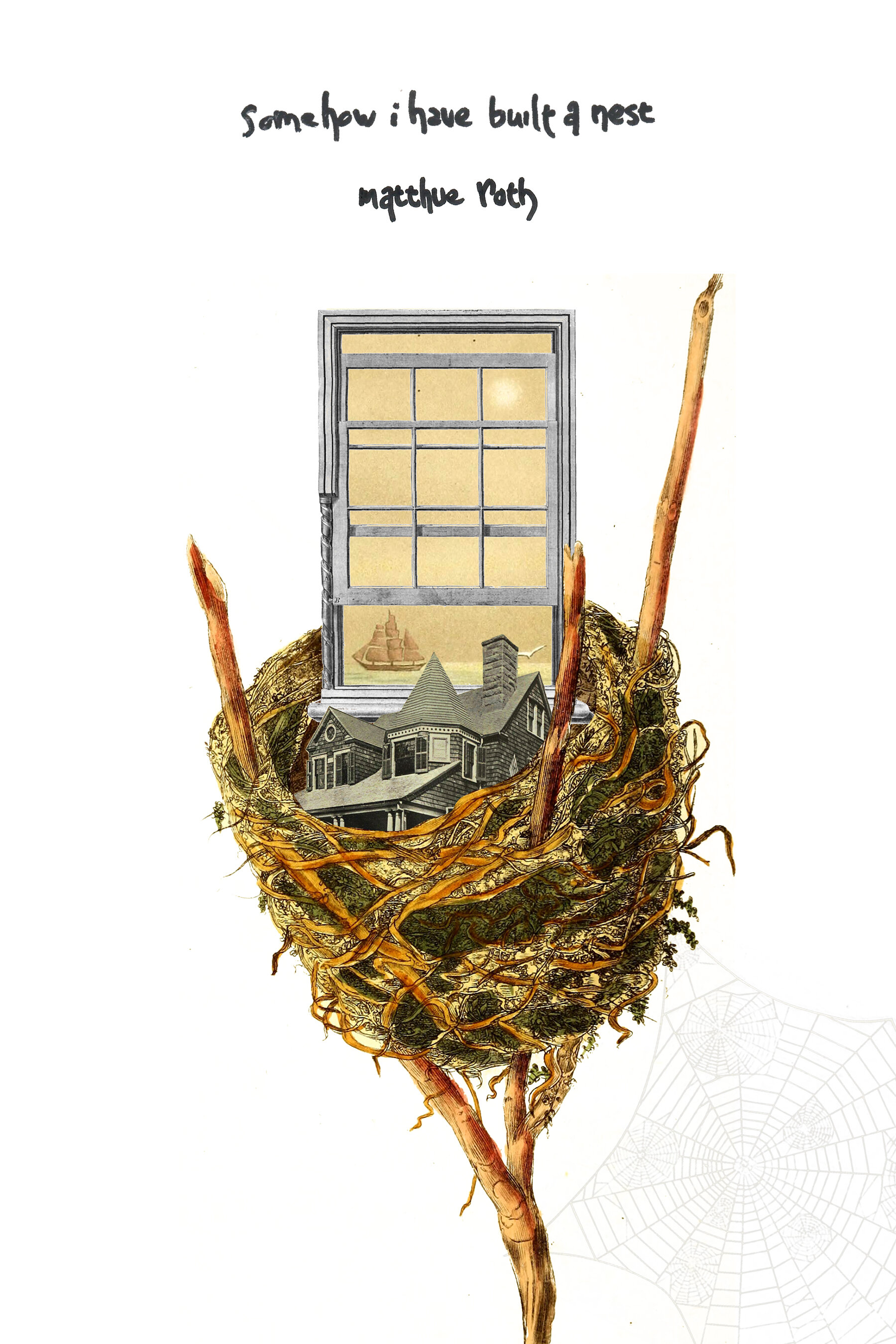
So, because it's late on the night before this is relevant...let me just put this out there to the universe and see what you think. My friend Josh Lamar and I did a song called "I Hate Xmas." It's about how I actually sort of like Christmas.
And if you look deep enough, you'll be able to see some strains of when I was in high school and joined this Christian fundamentalist Bible Club and got really into it...or maybe not? What do you think?
(You can also download an mp3 of my live show from a few years ago that features the poem, along with, uh, an 11-minute jam (I promise it doesn't suck) with some musical people about killing mice.)
Thursday, December 23, 2010
Jews Who Love Christmas
Tuesday, December 21, 2010
Singing and Dying
We love Regina Spektor -- I think that's been safely established. She has this Russian lion-in-pajamas thing going on where she's singing playful little lyrics in a soft singsongy voice, and then the moment comes (and this moment, in all her songs, it happens) -- catching you by surprise, with your pants down, just when you thought it was safe to curl up next to her -- and suddenly the song is all teeth and fangs, roaring down your door, throwing a wicked metaphor or a twisted simile, rocking and thrashing violently, the way only a piano player can.
It always happens, in every song. Sometimes it's a sudden switch of language, to French and Russian in "Apres Moi," or the drop of a delicate Jewish metaphor that you know she wrote thinking she'd be the only one to get it, but we're here, Regina, and we're listening, and we get it, too. And sometimes it's just the way she leaps into the microphone, ready to eat it, and gives the song a whole new energy.
This is Regina Spektor. Her new live CD+DVD, Live in London, was just released. It has 20 tracks, including a Guns 'n Roses cover (!) played with her string orchestra (!!). And each of those 20 songs are loaded with that moment, the moment of the bite.
I will admit to skepticism. I'm not one to fork over needed cash for an album full of songs I already have. But, along with the new material (including the song "The Call," a beautiful track which Spektor recorded for The Chronicles of Narnia--which made me do a doubletake; a Russian Jewish indie-rock hero recording a song for a Christian-fundamentalist fairytale adaptation made by Disney, the most massive corporation there is?--but she sells out in the most graceful and cool and still-righteous way there is, and it's a great song, and anyway, you can buy this recording and not have to give Disney any money) and the redone classics ("Eet," above, is electric, and "Dance Anthem of the 1980s" is awe-inspiring, especially Spektor's beatbox) all make it worth your while.
Okay. Deep breath.
But that singular spark of Spektor's -- the bite that I was talking about before -- it marks this disc especially. A few weeks after this recording, Daniel Cho, Spektor's cellist and musical director, drowned and died. And that eerie precedence fills every moment of this concert with a loaded, creepy, and beautiful foreboding. When you're playing a song with just a piano and some strings, there's a delicateness to the music, a sense that, if anyone were to stop playing, the song would fall apart. Maybe I'm just reading too much into this recording and this night, but I've been in bands before, and I know how much you're leaning on each other at every moment. And it feels like -- this night, or this moment, or something -- everyone's ready for something to break...and everyone is ready to catch each other when it does.
Monday, December 20, 2010
Losers. Goldbergs. Sale!
Last week! Next week, we're so back to normal...
Let's say you're looking for the perfect gift for the two coolest, nicest, and most interesting people in the world. And let's say you are a bit of a cheapskate -- but, for the sake of argument, let's say you don't want people to KNOW you're a cheapskate. What's a practical, easy, and brilliant way of getting two awesome presents for basically no money at all (or, alternatively, buying someone a gift and keeping one for yourself)?

Right now, buy my first book and my newest book, Losers and Never Mind the Goldbergs, for $12 combined. That's less than most single books cost -- unless you're living in Eastern Central Europe or something. Or the only book you read is the free newspaper they give out on the train.
To find out more about the books, go here for Losers or for Goldbergs. Or just ask me in the comments. All books come autographed (unless you specify otherwise), and all books come with free goodies, CDs or stickers or whatever I've got lying around. This deal will probably last a couple of weeks, but you probably shouldn't hesitate, because you will forget about it.
Friday, December 17, 2010
Tenth of Tevet! Stop Eating Now!
Today is a fast day, and it's a weird one.
The Tenth of Tevet, according to MyJewishLearning (you can read more here), is the day when the prophet
Yeheskel, together with the Jewish community forced into Babylonian exile, received news of the destruction of Jerusalem: "In the 12th year of our exile, on the fifth day of the 10th month, a fugitive came to me from Jerusalem and reported, 'The city has fallen' " (Yeheskel 33, verse 21). The BabylonianNormally, fast days almost never come on Fridays. I'd actually thought it was a halacha that you couldn't fast right before Shabbat -- and, in some cases, it really is; other minor fast days, like the Fast of Esther, get moved to Thursday or Sunday when they fall out on Friday. But Tevet is an exception, if a rare one (the last time this happened was 14 years ago). The reason is that the Tenth of Tevet is described as "עצם היום הזה ('the very day')," according to Yeheskel himself (who we like to call Ezekiel).Talmud in Rosh Hashanah tractate 18B even purports that the fast should be held on the fifth of Tevet and not on the 10th: "And they equated receipt of the report of the destruction with that of Jerusalem's burning."
My latest Jewish nightmare came yesterday afternoon, via my father-in-law. At the end of a totally unrelated email, as a sort of throwaway P.S., he wrote: "Have an easy fast and spare a thought for us who have to wait till after 9pm to break it."
Now, he lives in Australia, where (as you might know) it's summer right now -- meaning that the sun sets later. So, where a fast day in America might end at 5 p.m., there it's going to go way into the night. Yesterday, I was sort of upset and totally spazzing, and only the good graces of our good Editorial Fellow Jeremy Moses kept me alive. "Want to go out to lunch?" he said.
We did. To an amazingly luscious, colorful, and totally explode-our-stomachs-huge Indian buffet. Jeremy did two trips; I did three. Whereupon we shlepped back to work, stuffed ourselves into our chairs (I barely fit) and I read the email from my father-in-law.
And I felt my stomach retch. I feared of tasting that delicious lunch all over again. How could I have forgotten a fast day?!
Of course, you already know the moral. Part 1: Yesterday wasn't a fast day, it's today. Part 2: Australia is something like 16 hours ahead of us. My father-in-law emailed me at about 4 a.m. (which, for him, is already mid-morning). And I'm still not perfect, but I'm working on it. We all deserve a second chance. Even if it happens in that Groundhog Day-like way of experiencing the same day twice, courtesy of Australian time.
Thursday, December 9, 2010
Sweet Child of Mine, Please Shut Up

Something that worked 100% last time -- stroking her back, holding her just so, with one cheek smushed up against the crux of your elbow and the other draped loosely over the fingers of your other hand -- will have no effect whatsoever the next instance that she refuses to go to bed. And sometimes, doing one little thing -- like stroking her forehead just above her eyes -- will cause those eyes to grow heavy, sink, and shut in no time at all. Just one more way that G-d screws with our minds. And all the time she's crying, you are powerless to make it stop. You try and you try, but the truth is, she's the one who's going to decide when to go to sleep, not you. You just keep praying to yourself silently: Stop crying. Please, just stop crying.
But the thought that's been going through my head lately is of this story.
This is an awful thing to read, and unless you're one of those goth kids who still peeks at their own healing scars under a band-aid, feel free to skip to the next blog post.
It's a story about a Lebanese terrorist who was apprehended in 1979 after killing an Israeli policeman and bludgeoning his 4-year-old daughter to death with a rock. He was freed in July, 2008, as part of a prisoner exchange between Israel and Hezbollah, shortly after I started being a professional Jewish blogger -- which meant that I was reading and writing about pretty much everything that happens to the Jews. Including this, which was a pretty big story.
But that's not the most horrifying part. While he killed the policeman and his daughter, the policeman's wife was hiding inside the walls of their house with their younger daughter. The baby was screaming, and the mother, while trying to quiet her, suffocated her in the process.
I have really bad luck singing lullabies to my kids. I get distracted by the crying and by watching them, and I can't think of any songs to sing. All the obvious choices -- "Rockabye Baby," "Dona Dona," "Sweet Child O' Mine" -- all go out of my head. I'm left grasping for whatever song I can think of, which is usually an Ani Difranco song, but has been known to be worse things. One night, the only song in my head was Ice-T's "Cop Killer," which I promise doesn't mean anything (I have good friends who are cops) but represents a period in my life when I was screaming a lot, too.
In some way, her crying is a reminder of our own mortality. We spend most of our lives not having control over everything, even our bodies, when they should be going to sleep but aren't. In another way, though, it's just my baby expressing her inner pissed-off-ness. I still stroke her back, but sometimes I force myself to take a mental step back and let her scream. It's all gonna be okay, baby. But that doesn't mean you can't express your feelings on the matter.
(Crossposted at Raising Kvell, which is where the picture comes from. The editor found it and I love her dearly, but it is kind of gross. Or maybe I'm just old-fashioned and expressing my subconscious heterocentrism and don't like naked dudes with chest hair? Sorry. Still true.)
Thursday, December 2, 2010
Drinking on the Job
Being an editor at a Jewish blog has its perks. Sure, there are the long hours and lousy pay, but you get tons of review items in the mail. Usually they're book-shaped or movie-shaped. The other day, we got a beer-shaped package.
I don't know if you've ever had He'Brew Beer, which sounds like the sort of kitsch that your weird uncle would give as bulk Hanukkah gifts, but is actually an incredible-tasting microbrew from San Francisco. If you saw yesterday's Jewniverse, you'd know. And you'd know about the incredible Jewbelation 14 -- a blend of 14 malts, 14 hops, and 14 percent alcohol. Zowie!
(And, if you read my work blog, you know that most of the MJL staff are women. Weirdly, only the boys were around that day. Two of our editors having babies in 2 weeks might have had something to do with it. But apparently beer is good for increasing your milk supply, so we'll have to try this again once everyone's respective maternity leaves are over.)
Wednesday, November 24, 2010
Jewish Christmas Music, 2010 Edition
You know, I don't think I've ever actually heard "White Christmas."
Sure, I know that it was written by Irving Berlin, a Jewish immigrant, and that it's become a vital part of American culture. I'd definitely heard part of it before, the end part, where everyone sings "may all your Christmases be white"...but does the song really go like that? Is it really sort of pretty and actually funny? Does this make me a bad Jew? (Add this to the fact that I admitted on our Jewish parenting site that I actually like Halloween, I'm about to be kicked out of the so-Orthodox-I-don't-own-a-TV camp for reals.)
read more -->
Thursday, November 18, 2010
Pixies and Magical Miniature Butlers

Don't get me wrong--I love living near a zillion cousins-in-law and a gabillion kosher restaurants. But you know how people say that, in L.A., people say "thank you" but mean "f-- you" and in New York, they say "f-- you" but mean "thank you"? Well, I'd rather people hated my guts but were still polite about it.
The Village Voice just came up with their list of 50 things to love about New York. And, fresh off another shift at the Park Slope Food Coop, I fell in love in particular with #25:
25. Except in select 'hoods like Park Slope and perhaps the Upper West Side, children are viewed as mysterious beings, rarely sighted and only occasionally understood, like pixies or magical small butlers. Until they scream, in which case, they are banished from the palace.
Admittedly, we sometimes are not very good about that (example: seeing Scott Pilgrim in midtown, when our infant was totally quiet for an hour and 25 minutes and then screamed her head off during the last fight scene. (I know, go figure.) But in all other instances: yes.
I really do live in two worlds. At home in Brooklyn, everyone has kids -- often 5, 7, 12 or more. When I'm at work, or hanging out with my non-Hasidic friends in the city, though, my kids are like aliens. (Friendly, curious Gizmo-like aliens; not like Alien aliens.) They are treated with curiosity, amazement (childlike amazement, you might say) and utter wonder, the kind given to roadshow zoos and Times Square subway dancers: Do these things really exist? Can people be that cute without the assistance of Japanese animators?
In general, I prefer the Brooklyn side of things. We live there. We don't have to watch what we say, translating every Hasidic idiom we drop and making sure we don't talk about our kids too much. But the other thing about kids is they wear you out. You have other things on your mind that have nothing to do with them (job, bills, the Buffy season you're in the middle of watching), but the things that they have on their mind (food! peeing!) always involve you.
And therefore, it's a relief -- sometimes a huge one -- to remember that the island of Manhattan exists, to jump on a subway and watch your hipster friends fawning and E.T.-ing over your miniature heirs. Oh, you will say to yourself,they really ARE wonderful and miraculous -- and you'll be right.
Of course, there are limits. Whilst hanging out with my friends Jason and Emily a few weeks ago, I casually mentioned how it's hard to find a good babysitter -- whereupon they jumped at the opportunity. "Call us!" they raved. "We love kids! We won't even charge you!" You do realize, I asked them, that we get babysitters at night, when our kids are asleep? "Oh," they said, shuffling their feet. "Never mind." And then they bought me a beer -- as a consolation prize, I guess.
Tuesday, November 16, 2010
Jaws
We watched Jaws tonight (on Netflix Instant--is there someone who keeps a list of amazing movies on Netflix Instant, to weed out the great stuff from the trash?) and I am agonizing, agonizing. Every scene of that movie is so well-thought out. Made in that way that movies don't get made anymore, with long lingering scenes and visuals that any 12-year-old would decry as fake in a second, but you know that's the way these things work in real life. One second you're just smokin' a cigarette

and the next, you're, well, lunch.

Then of course, because I am obsessive, I dove into Wikipedia and read about the Hollywood impact of Jaws (and read the complete Wiki summaries of its three sequels, which is probably as close as I'll ever get to watching them) (not because they're bad -- usually that's an incentive to watch movies, peoples -- but because of the no-time thing). And that studied, minimalist storytelling thing (there are, what, 3 scenes that comprise the entire last hour of the movie?)...yeah. It kind of doesn't show up in the sequels.
I'm the last person to say that fast and furious isn't a great way to tell a story. I like to think that Losers, in its 189 pages, is the two-minute punk version of a five-minute anthem. But slow can be good too. (Please don't take this theory and apply it to the Green Day musical. I mean, come on. Green Day. Made a musical. I'm sure it's good or whatever, but please don't tell me.)
It's also National Novel Writing Month. I've definitely written novels in a month before (Stephen King says to write fast, while the idea's fresh in your head, and edit slow) and I actually did the November 1 - November 30 thing once. But this November I'm taking it purposefully slow. I've been working on this book for ten years -- I remember because the main character used to seem way too old for me to write him, and now I keep wondering if he isn't way too young. And I'm writing a book where the main character is a dude. Why does that keep weirding people out?
(Okay, so realistically, of the 4 books I've published, 2 have had male protagonists and 2 have been female. But, of the boys, one was a memoir where the protagonist was me {well, more or less me} and one was basically a 14-year-old version of me. {There's a longer answer to that, essentially, that Jupiter isn't me, he's my best friend, only Russian and Jewish and not dead. But that's another post, I think.} And then my two ladies, Hava from Goldbergs and Candy from Candy in Action, are both basically superheroes. Which says something about how I variously idealize and torture the people in my books, right? How did I start analyzing my own books? I should stop. Now.)
Annyway. I planned to come on here and write about Jaws for a minute and then leap back into the book and as you can see, that hasn't really happened. But Bram from YIDCore is asking me questions about his new book and I have about 20 pages of tinily-lettered rewrites to type and two tiny children who are already plotting their evil ways to wake up at sunrise, which suggests that this should be the point where I jump into the water, make my own fingers-pressed-together shark fin, and do my slow descent.
Only, not slow anymore.
Thursday, November 11, 2010
Kosher Nation
Why do we love to read about food?
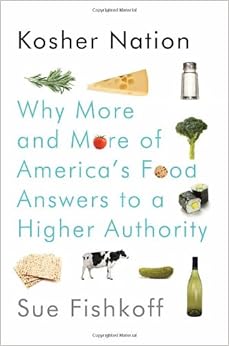
I'm in the middle of Kosher Nation, a history of kosher food in America. The if the industry is a veritable behemoth -- kosher sales, according to writer Sue Fishkoff (who blogged for us last week), make up a billion-dollar subset of the American food industry -- then this book is a travelogue of its guts and insides. Fishkoff writes with a surgeon’s steady hand, casually recounting episodes in the past few hundred years of kosher food in America in between these bizarrely compelling interviews with kosher supervisors, Reform and independent rabbis, and Chabad rebbetzins who give challah-baking classes. In a nutshell, she talks to virtually everyone across the spectrum who has something to offer to the discussion of kosher food in America -- what it means, where it comes from, and why people care about it.

I love food writers. (It’s not just that I’m married to a meat-loving personal chef, I promise.) I’m fortunate to work with two of the best, Tamar Fox and Leah Koenig, who aren’t just foodies but writers with a lust for flavor: When they write, you can feel the saliva sandwiched between the words, oozing out. People are surprised by how many food books are coming out these days, but they shouldn’t be -- just look how much erotica/porn/gossip/dating books are written and published every year. People love reading about sex because we all have it (or want to). But we’re so damn intrigued by reading about food because we constantly have it. And need it. And, just like skeletons, we all have one, but we’re never sure what they look like up close -- and when we see it from afar, we’re both scared and fascinated.
Fishkoff is a great writer, and it’s easy to imagine her sleeping in a bed each night surrounded by kosher symbols and diagrams of cut-up kosher animals. But the passion that people are already feeling about her book -- that gets me wanting to read passages out loud to everyone in the room at the time -- isn’t just the mark of a great book. There’s something about food that fires us up, that makes us more personally invested.
Maybe it’s that we all eat. Or maybe it’s that Fishkoff and Foer, in writing about where our food comes from, know more about what we’re eating than we do. And in their stories there isn’t merely an emotion that we recognize, but a pre-conscious action that they’re defining for us, peeling away the layers of flesh and showing us what we look like on the inside.
Tuesday, November 9, 2010
The Moment When All Prayers are Answered
When you pray by the first light of dawn, the Talmud says, Heaven pays attention to your prayers immediately. And when you time your prayers so that they culminate with the Amidah prayer at the moment that the sun breaks the horizon -- again, according to the Talmud -- that's the moment where the gates of heaven are flung open unreservedly, so that any prayers are answered immediately and without question.

My daughter is still on East Coast time. She woke up at 5:00. This is the sunrise over the Pacific Ocean from the villa we've been staying at. (We're down the street from Julia Roberts and one of the Red Hot Chili Peppers. Although, at this particular moment, none of that earthly name-dropping stuff seems to matter.)
Monday, November 1, 2010
Kobi Oz, You're My Hero (most of the time)
So I'm editing this little daily email called Jewniverse, which tells you about one cool/amazing/unusual thing each day that you've never heard of. (If you're like my mom, someone probably forwarded you this thing about a Yiddish workout video about five thousand times in the past week; and we also show you things like rabbis in space and a blessing over weird fish.)
And this is one of those little behind-the-scenes stories that would go on the director's DVD commentary, if emails had that sort of thing.
A few months ago, I was at the ROI Conference in Israel -- which was mostly a way for a bunch of Jews with wacky ideas to get together and trade ideas and get blown away by each other. We had one big, intense networking night, culminating with a concert by Koby Oz, lead singer of Teapacks -- who caused the biggest stir in years at Eurovision with this awesome/insane performance about Iran:
Oz -- whom you'll notice in the video, wearing the wild beret and that great vest and doing drop-kicks -- just released a solo album. The ostensible highlight of the networking night was a performance by Oz and his band. Except that, because (a) the audience was composed of funders and prospective fundees, and (b) you had a handful of us wacky Orthodox Jews, nobody really paid attention. The event happened during a mourning period called the Three Weeks, when some people don't listen to live music -- so I ran to the Western Wall and had my own punk-rock crying freak-out and then unexpectedly ran into my favorite Hasidic movie star.
Flash forward, and -- equally unexpectedly -- I get Koby Oz's album in the mail.
And, most unexpectedly of all, I listen to it. And it's freaking amazing.
It's unexpectedly quiet and reserved and meditative, featuring a duet with his dead grandfather in that Nat "King"/Natalie Cole style -- only, Oz's grandfather is a Yemenite cantor, and the song is about God.
I won't tell you much about the album -- you can read the Jewniverse for that -- except to meditate on the irony of it. Oz, a secular, Tel Aviv-based Israeli musician, makes this album whose name (Psalms for the Perplexed) is a subtle pun on two major religious works (Psalms, of course, and Maimonides' Guide for the Perplexed) and whose entire concept is exploring what is and isn't religious, what it means to be Godly in our society and to ourselves.
In short, it's a game-changer for the entire genre -- an album of love songs about God.
Dammit, Mr. Oz. I'm stunned. I'd take off my hat to you -- but, you know, it's a yarmulke and all.
Thank you.
Monday, October 25, 2010
Getting Down to Business

Loved your article in Kvell. I think it takes being a parent to be able to somewhat understand what your parents went through. Just remember the time flies...in the blink of an eye they grow up sooo quickly!!! Enjoy and cherish every moment with them. Much love, MomAs much as I wince, there are a lot of things that move too fast. I watch our baby rolling around and crawling (yeah, that's right! at 4 months, suckas!) and I'm reminded of all the things our older daughter doesn't do anymore -- things I'd once loved and relied on and depended on her doing forever. How she used to scratch at my paisley and try to stand up while holding onto my payos. How she'd try to suckle on my nose.
But the truth is, there's a lot of shit that they do that I'm never going to forget...and most of that stuff has to do with poop.
My wife and I never went in for that "whose turn is it" routine. For one thing, when our first child was an infant we were both alternately knocked out from sleep deprivation (her from feeding, me from coaxing the baby to sleep and then not being able to sleep myself)--so we resigned ourselves to the simple rule that, whoever could stand without falling, they would have to change the nappy. Now that I have (ahem) a full-time job, we've sort of evolved: My wife does the nighttime stuff, and I wake up with the kids, handing over the torch when I have to catch the subway. It's efficient, but it's also sort of awful: This tag-team parenting pretty much assures us that all four of us are never awake, functioning, and just hanging out at any time during the week.
And, in that tag-off, more often than not, the only communication we have goes along the lines of:
- how big a particular cucky* was,
- what color (or colors) it most closely resembled,
- how bad it smelt,
- and the exact amount of time spent cooing or tickling or teasing (or letting her suck my nose) it took to forget about the trauma and remember that we had just created a bundle of gooey goodness.
In the wake of my anxiety disorder, I would pretty much vomit at will. When I had to turn in a new draft of my book. When my parents called. When the bus was five minutes late. Whenever something happened that was out of my control, my body would react by losing control as well. And now I'm holding this creature who's just learning her way around her body, figuring out how to move her fingers one by one and to put herself to sleep without crying and how to, well, piss and shit. In a weird, raw way, it is a miracle. The blessing is one of the longer ones, way longer than "Thank you God for making bread." If one of our openings should close, or if one of our organs which is closed should open, it would be impossible to stand before You. It's the barest fact of our existence: the only reason humanity exists in the first place is by the most tenuous combination of neutrons interacting with each other, holding all our cells together in a human-shaped shape. Keeping together the parts that are supposed to stay together. Excreting out the rest.
As I mop my kid's tushy, cleaning off the parts of her food that don't get assimilated into her body, I know that her body took care of the important part. Somehow, it knows how to separate the important stuff, vitamins and proteins and stuff, from this gunk. I'm just doing the grunt work.
But I'm okay with that.
_________
* -- Our word for shit. I still haven't determined whether it's Yiddish or Australian; all I know is that we grew up calling it a B.M.
Wednesday, October 20, 2010
My Books, Super Cheap, and a Bunch of Other Stuff
A couple of random thoughts, too long to tweet about but short enough to shoot a couple of bullets through. Some of them are kind of literary, but you'll be fine. Just Google them if you don't know, because they are all worth Googling:
- Tonight in New York, the legendary CAConrad is reading at St. Mark's Church, and it's free, and (as of 9:53 a.m.) I'm actually going to go, but I don't have anyone to go with. His new book The Book of Frank has an introduction at the end that's written by Eileen Myles, the most famous poet of ever, and it's $16 with free shipping here.
- Armistead Maupin has a new Tales of the City book out, and it's about Mary Ann, who I always thought was my least favorite character, but the giddiness I am getting in my stomach from having just found out about it might prove otherwise.
- I'm on the editorial staff of Kveller, a new magazine that's not about Jewish parenting (but is about the intersection of Judaism and parenting, whatever that means), and I just wrote a new blog post for them, which is called The Bad Cop. It's about dads.
- And I'm obsessed with the writer Sayed Kashua, who wrote the series Arab Labor and wrote the book Let It Be Morning, both of which I read/saw this week. Here's more blog love for blogs that are not my actual blog: the book and the TV show. Unless I'm wrong (am I?), he's the only primarily-writer author who's currently writing an entire TV show by himself, except for Jonathan Ames (who I gushed about here).
- Oh. And I just ordered 200 copies each of Never Mind the Goldbergs and Losers in the mail. Bigger announcement about this to come, but now you can order both of them, signed by me and with a free CD and other stuff thrown in, for $12 together: Click here for the luminescently special deal.
Wednesday, October 13, 2010
Great House - National Book Award Finalist
A day after its release, Nicole Krauss's novel Great House was named a National Book Award finalist, which is either a great bit of luck or a great bit of marketing.
It's not surprising, though. The novel -- which tells the story of a massive desk (yes, a desk) that trades owners from a middle-aged writer in the USA to a vindictive Israeli Holocaust survivor to a South American radical -- is sprawling, confusing, and beautiful. It's a book that makes you kick yourself and bite your tongue because it's so full-on and self-centered (you'll see what I mean in a second). But, at the same time, it really is great.

And that's the first chapter. I didn't spoil it, I promise -- you know every detail of the story from the start, except where the plot is headed from there. Where it's headed is in a number of different directions, with several disconnected stories that intersect at times but never entirely unite. It's quite beautiful, but it's like watching a movie you know is supposed to be great. You're never sure whether it's actually going to entertain you, in the end.
Whatever Great House does, it does to 100%. The book is made of two parts and eight chapters, each told by one of four narrators. This sounds confusing, but it's actually not at all -- the stories are so distinctive and remarkable, and each cuts off at just the right point, that you thirst for resolution until the latter half of the book. All four narrators basically share the same voice -- you know this voice; it's a thoughtful, carefully meandering New Yorker-style of monologue. There aren't even quotes around dialogue. Also, nothing happens. There's no character progression, not for the main characters, anyway. Each is narrating the story in one place, unmoving, with full awareness of his or her audience and position as a storyteller.
Not that I'm complaining. Even if the characters all talk the same, the voice is so compelling that it's hard to nitpick. Metaphorically or literally, she's caught all of these characters in a moment between drunkenness (painful, honest drunkenness) and standing on death's door -- those times where people are most candid, blunt, and where they can see the sum of their lives.
GH takes its name from a story at the book's very end -- a story snatched from Rich Cohen's book Israel Is Real, who snatched it in turn from the Talmud. In the end, you'll realize, Great House was in fact entertaining -- each moment of it, you're in the moment, even if it's only a single moment that lasts through each of its 30-page chapters. I still can't tell you exactly what happened in the book, but I can tell you I'm already feeling nostalgic to go back and revisit it.
but the voice is so compelling that it's hard to nitpickN
Monday, October 11, 2010
Banksy's Simpsons Intro
 , which is the only children's book I know of about graffiti and art terrorism.
Subscribe to:
Posts (Atom)