Just spent way more time than I realized on the phone with some folks at National Geographic, who are planning a documentary on the baal teshuva lifestyle -- that is, people who weren't born Orthodox who somehow or another wind up that way.
"Yeah," I said with a nervous giggle that I wasn't sure where it came from, "I'm a baal teshuva." And right away, it felt like I was admitting something, like I'd come out of the closet with a deviancy that was way too obscure for anybody in the room to know what I was talking about, but which was nonetheless embarrassing the hell out of me to say aloud.
And I wasn't even 100% sure why. Admitting that you didn't grow up Orthodox should be as easy as admitting you didn't grow up Buddhist (for a white person, anyway) -- it's not like anyone expects a fresh-faced kid who can't pronounce Hebrew right and just barely knows how to keep a kosher kitchen to be undetectably Orthodox.
But when you're first starting to be a religious Jew, the last thing you want is to stick out. You want
So I told her my story. I told her how I became Orthodox on my own, outside of a community (in San Francisco, with a bunch of middle-aged gay men teaching me to be Orthodox and a bunch of female-to-male transsexuals teaching me how to act like a guy). I told her about wanting to do Orthodoxy my own way, and then marrying into a family who'd been Hasidim ever since Hasidism started. I told her about how you start thinking in two different languages, one in your job and with your old friends and another with your new friends and the new places you hang out with, how you spend all your time inside a synagogue with random men who you'd never hang out with on your own, and how even your wife doesn't totally understand the life you used to lead.
I realized about two minutes in that I was basically just narrating my memoir (the seasonally-apt Yom Kippur a Go-Go
And then, about half an hour later, the National Geographic person (who was being very kind and patient with me) told me that, uh, they were looking for recent baalei teshuva. That is, people who were just starting to become religious, and had just moved into religious neighborhoods.
"But I'll tell my producer about you," she promised.
And then she asked if I could find a baal teshuva (or a few) who might be interested in being profiled.
I reiterated her biggest problem -- that recent baalei teshuva don't want to be stigmatized as baalei teshuva. Not to mention the whole film-crew-following-you-around-as-you-try-to-learn-about-your-new-life thing. But hey, if they cast Jersey Shore, that shouldn't be a problem. Also, for most people I know, Orthodoxy isn't really a gradual process -- people wade in the pool a little, and the next thing you know, they're either living in Bnei Brak with a pile of Shabbos stones or they're straight back to being hippies or investment bankers or reggae singers or whatever they were doing before they started being frum.
So there you have it. Are you a baal teshuva? Do you know anyone? Give me a shout, and I'll hook you guys up.
Wednesday, September 15, 2010
Casting the Perfect Baal Teshuva
Monday, September 13, 2010
Half a Life, by Darin Strauss
It’s a bizarre concept, but it’s kind of thrilling, in the same way that watching horror movies is thrilling: the inevitable chase, the will-he-get-there-in-time?-ness, the fact that you’re not really sure who to root for: the grieving family, or the poor sap whose fault it was.
 Darrin Strauss’s new memoir Half a Life, which comes out this week from McSweeney’s, is a case study of this sort of event. At the age of 18, two weeks before graduation, Strauss was driving when he killed a girl from his school. The police called it an accident. But for the past 20 years, Strauss has been haunted by her memory, guilty for having survived, and tortured by the girl’s mother’s plea to him at her funeral: “You’re living for two people now.” (Strangely — and, as in real life, this is never resolved in the book — soon after they promise not to hold it against them, Strauss finds out that the girl’s parents are suing him for several million dollars.)
Through Half a Life, Strauss’s most painful memories are the ones he causes himself. He confesses the accident to women he dates. He constantly confronts her memory in his actions, in his writing, in major life events like going away to college. And he lets it get in the way of his marriage and his fatherhood: “How often do you think about it?” asks his wife, and Strauss is startled by his own answer: “A lot less than I used to think about it.”
These days, the Cities of Refuge no longer exist. But that feeling of guilt that the Torah acknowledged in creating them is no less real, and our basic human need to let this guilt transform us and give our life a new direction–whether it’s starting over again in a new city or transforming that sadness into a profound and moving book.
Yom Kippur with G-dcast
After the onslaught of Rosh Hashanah videos, seems like the least that G-dcast could do would be to make something that full-on fist-pump rocks us out to the Day of Repentance.
And that's not all! Sukkos is coming next week. The holiday, and also the video.
Wednesday, September 8, 2010
My Favorite Jewish Writer
Recently, Moment magazine asked me to write an entry for their "Speaking Volumes" series. They approach current Jewish authors and ask them to write about authors who've influenced them.
Over the course of the next five minutes, a name popped out. I said no, then 
Unlikely enough, the folks at Moment loved it. My favorite Jewish writer was a Spokane/Coeur d'Alene American Indian.
Alexie wasn’t writing about “every Indian’s experience” and he wasn’t trying to. He’s just this person who happens to be a lot of things—Indian, thinker, queer advocate, zombie fan—and his writing encompasses all of it. He’s not the definitive Indian writer any more than he’s the definitive zombie writer; he’s just Sherman Alexie. And that might be the most profound statement he could make.If you don't know about Sherman Alexie, read more here, or read his short story "Every Little Hurricane." Or just go and read my article.
MORE >
(Confession time, which should come as a surprise to nobody: I was originally going to ask if I could write about Dara Horn, who might be my favorite Jewish writer. And then I checked Moment's site and realized that Dara Horn had already written her own "Speaking Volumes" column. But the more I think about it, the more I'm pretty sure of my choice: Dara Horn writes about Jewish traditions and ideas amazingly. But I didn't know how to write about actually being Jewish until Sherman Alexie came along and punched me between the eyes.)
Tuesday, August 31, 2010
iHappy Rosh Hashanah
Okay -- maybe you get more email forwards and cheesy Facebook photos sent to you than I do. (It's not that hard to achieve, I assure you. Between getting Jewniverse ready, re-watching the awesome new G-dcast video, and keeping on top of office gossip, I barely have time to read my own email.)
So -- yeah -- maybe you are cooler than I am.
But my grandmother-in-law is cooler than you are.
Check out this Rosh Hashanah card that she emailed us. Yes, my grandmother-in-law uses email. She escaped the Holocaust by walking barefoot through Siberia and she has an email account. And she has an iPhone. An iPhone! My cell phone can barely still be held together with a rubber band and some chewing gum.

Happy New Year, everyone. And may all your computational devices taste as good as hers.
Friday, August 27, 2010
G-dcast's Rosh Hashanah Music Video!
Prodezra, the hip-hop sensation out of Savannah, GA and Mayanot Yeshiva and into our ears, stars in G-dcast's new Rosh Hashanah video -- dropping rhymes, mixing beats, and playing his own shofar backup. Prodezra and I wrote the song. And then we made it into a music video.
And don't forget to come back the second Rosh Hashanah goes out -- we've got Yom Kippur on deck, with the cowriter of the new Sleepless in Seattle musical, Josh Nelson.
Tuesday, August 24, 2010
Win Stuff With Poetry.
How are you feeling about the New Year? Excited? Trepidatious? Nervous? Whatever's going around in your head, you should get it out of your head -- sit down and write a poem. (Or, if you're more in the mood, stand up and yell it out...but make sure you write it down or record it!)

Of course, even if you don't enter, keep your eyes peeled and your RSS feed set to stalk the MyJewishLearning blog, where we'll be announcing the winners and reprinting the winning poems.
And if you need some inspiration, check out MJL's High Holidays section -- and our great guide to the Rosh Hashanah season, 10 Days to a Better You.
Friday, August 20, 2010
The Blaxploitation Shofar
This post came our way courtesy of Alan Jay Sufrin, singer/guitarist/bassist/keyboardist for the band Stereo Sinai. He's also the official shofar blower at Anshe Shalom in Chicago this year (and is tremendously excited about it). Here he is with his newest instrument in the recording booth.

So, here we go.
It's the Hebrew month of Elul, during which it's a custom to sound the shofar every day. The blog HearingShofar (which, amazingly, is a year-round blog about shofars) just reprinted a page from the comic Teen Titans #45, from 1976, in which Malcom "Mal" Duncan, DC Comics' first black superhero, is attacked by a shadowy figure who promises to kill him. Then, randomly, he receives a magical ram's horn from the angel Gabriel.

According to HearingShofar:
[T]he tale seems kind of goyish. But hey, Superman was invented by several Jews and much has been written postulating how Jewish legends and archetypes influenced the creation of his character. And we are instructed to sound shofar in times of crisis, just like Mal is.
Which reminds me of a joke that my friend tells way too much -- as illustrated by the illimitable comic artist Mat Tonti. What do pirates say to each other on Rosh Hashanah?

Happy Elul, everyone. T-kee-yorrr!
Wednesday, August 18, 2010
Beginnings: Jewels of Elul
I decided to be Orthodox in the middle of college. I was on scholarship to a very big school, and I was feeling very small. One of my best friends had just gotten raped and then sort of ignored by most of our circle of friends, and ran away to Europe. I'd thought I was going to New York for college, then realized that going to New York for college actually cost money, and so I was back in Washington D.C. on scholarship and with noplace to live.

And it wasn't like I was choosing to change. It was a side-effect of being around different people every day. No one expected me to say "the Matthue thing," whatever sort of thing I always said, or to behave a certain way. I was getting born again every day. If I wanted to skip breakfast, how would they know I had a rigorous routine of a bowl of Cheerios with soy milk every day since 9th grade? Boom. Today, I am no longer a breakfast eater.
But I had all this time. I'd been hanging out with my friend constantly and now she was gone. I'd been searching for a place and now I was promised one; I just had to wait three weeks for the old tenant to move out. It was maddening. I didn't know what to do with all this time. Study more? No; it was college. Why would I do that? Write a book? I'd just written a book. It took time, but not the time I had free -- that was for late nights and early mornings. In my life now, where I used to call my friend constantly or hang out in the privacy of my room, there was just an empty silence.
On Friday I was crashing with the guitarist from my band. He was going to a concert in Alexandria; he left me the keys on the bureau and headed out. Faced with a rare weekend night with no plans, I asked myself the question that, in college, surrounded by a million other people, you never actually ask: What do I WANT to do?
I went on a walk. I didn't carry anything -- not my phone, not my wallet (which was falling apart anyway), not even an ID, just in case I got lost and drowned or the Washington Monument fell on me or something. I was a notorious worrier. I actually thought about these things constantly. But not tonight. I didn't want to worry about anything.
I ended up at synagogue. I'd always known where it was; it was in the middle of Georgetown. I'd just never gone inside. But a hundred other people walking in at the same time, I could do it without anyone noticing. I prayed in the back of the room, alone and with my prayerbook in front of my face. A hundred other people prayed under their breaths; it was a huge noise composed of whispers. In that noise, I could say anything I wanted.
That's when I decided to start coming back every day.
They say, when you want to become an observant Jew, you should do it with baby steps. Stop watching TV for one Shabbat. Give up the Internet a few Shabbats later. I didn't work that way. I dove in. I had all this time, remember. What was I going to do with it? Something productive. And it ended up being something productive in a way that wasn't going to be like publishing a story or playing a concert. Praying is like giving up your time and your energy and your creativity. But it's like giving it up for a reason; saying that I don't just need to impress the people around me. Believing that that's not all that matters.
I talk a lot; you could say I've made a career out of it. But this talking alone -- talking where nobody else can hear you but G*d -- is, in my very small way, saying that not everything I do has to have a specific reason, for work or for my friends or for my writing. Sometimes, you're just giving it up for G*d. Are my prayers going anywhere? It almost doesn't matter.
I became Orthodox overnight. But becoming religious -- that's taking a lifetime.
Crossposted from Mixed Multitudes. This post is part of Jewels of Elul, which celebrates the Jewish tradition to dedicate the 29 days of the month of Elul to growth and discovery in preparation for the coming high holy days. This year the program is benefiting Beit T'shuvah, a residential addiction treatment center in Los Angeles. You can subscribe on Jewels of Elul to receive inspirational reflections from public figures each day of the month. You don’t have to be on the blog tour to write a blog post on “The Art of Beginning... Again”. We invite everyone to post this month (August 11th - September 8th) with Jewels of Elul to grow and learn.
Thursday, August 12, 2010
We Are Not Eaten By Yaks
The noble explorer C. Alexander London, who was last seen blogging about visiting Jews in strange places for MyJewishLearning, has a new book coming out. It's called We Are Not Eaten By Yaks
If you don't want to read a book called We Are Not Eaten By Yaks, I probably can't have a meaningful conversation with you, but just in case you need further convincing, Mr. London has created this book trailer. And tell me he doesn't look exactly like Doctor Who, and every time he opens his mouth and an American accent spills out, you want to say, "really?"
Which I hope he doesn't take umbrage at. Most of my friends don't even look like Doctor Who in the first place.
Thursday, August 5, 2010
Snoop Dogg and Kosher
Maybe it's the fact that all the Israelis I knew growing up were seriously cute girls (Orali in fourth grade, I'm looking at you), but Hebrew versions of words always sounded so...cute. I'm not talking about the guttural ch that pops up everywhere. But the rest of it -- the doubling-up of words (kacha-kacha), the addition of -y to every name, whether it makes sense or not (for years, I was "Matty" to every Israeli I knew), the fact that Israelis always sound so condescending when they deign to speak English to us non-Israelis -- just strikes me as really sweet and 10-year-old-like.
You know who else uses made-up words and suffixes a lot? Snoop Dogg.
Keeping all this in mind,there's a new kosher restaurant in Brooklyn. I don't know what the name is supposed to mean (it's a dairy restaurant, and, like every other kosher restaurant in New York, they also serve sushi), but it's called Shabazzle.

What do you think -- is Shabazzle an Israeli way of saying "yummy"? Or the Hebrew vernacular equivalent of "Yo, party's on Coney Island Avenue"? I couldn't tell you for sure. Clearly, though, it's an example of Israeli cute-ification in action.
And clearly the sort of place that Snoop Dogg would eat at. If, you know, he was Shomer Shabizzle.
(Thanks to the awesome kosher blog Thanks A Glatt for the tip.)
Saturday, July 24, 2010
Jews of the Future
Oh, hey! Check it out: My article for Patheos on Orthodox Jews and technology got picked up by the Washington Post and Newsweek!

(I know, it's exactly the same article as I already told you about, but I'm still pretty psyched. Okay. Now I've got to get back to the wedding parties...but I'll see you when I'm back in the States.)
Oh, and thanks to Natasha Nadel for letting me know!
Monday, July 19, 2010
Schindler's List and Hip-Hop Remembrance
When I was in Junior Congregation services at OCJCC-BI in Philadelphia, we spent Tisha B'Av -- the holiday that's the anniversary of the Temple's destruction -- watching depressing Jewish videos. Some of them (Shoah) conveyed the appropriate they're-dead-and-it's-sad response from my 12-year-old self. Some of them (Schindler's List -- specifically, the scenes of Oskar Schindler in bed with the naked bouncing-breasty women getting all pogo-stick on top of him*) left, uh, a different image in my head.
The London-born, Jerusalem-based poet Danny Raphael just laid down some rhymes of remembrance. It's only 2 minutes long -- and, back in 8th grade, I wasn't very open to appreciating hip-hop -- but I'd like to think that I would've appreciated this.
* -- It feels like heresy to say, but as a geeky barely-teenage boy who'd just seen Jurassic Park (loved it) and was expecting something I could do a Hebrew School book report on, it was unexpected, to say the least. There was plenty of stuff that depressed and inspired me, as well, but when I left the theater that day, the sole image that stuck with me was not a skeleton-thin man behind a barbed-wire fence but a full-bodied woman who touched off a strange chord of both attraction and haunting in my spread-wide-open impressionable mind.
Now, this isn't to say that I disapprove or disagree with the film. I think the only people who wouldn't say Schindler's List is a work of art are either anti-Semites or jealous (the latter category includes all you film-school snobs). The most common feedback I get from my book about becoming religious is that it'd be a great story except for all the cursing and sex. Real life is real life, and portrayals of life are going to contain stuff that isn't exactly ready for prime time. Was I ready for it as a kid? I don't know. Although, on the other hand, most of my formative life-changing experiences were things I wasn't ready for. And this would be the footnote that's longer than my actual blog post.
Thursday, July 15, 2010
Rugelach and Blessings To Go
My friend dropped me off across the street and pointed out the shelter where the minibus stopped. "The 16 sherut will take you straight to the train to the airport," she said. "Don't get on the 4 or the regular bus." I wasn't sure if she was telling me to avoid the normal bus because it didn't go to the same destination as the sherut did, or because the large regular buses are often the target of suicide bombers. (They're larger, and they're government-subsidized; both are attractive reasons for a potential terrorist to get his bomb on.)
Not that it mattered. I liked the feeling of the private minibus. The clientele was a mish-mosh of scraggly hippie kids, snowman-shaped Russians, and old ladies with shopping trolleys bigger than they were. Before that, though, I stopped to pick up some rugelach.
Now, rugelach are an important part of any Israel experience. Fresh from the oven, painted with honey and sticky from melted chocolate and cinnamon that's still oozing out the sides. I know people who've finely tuned the art of buying a box of Marzipan rugelach straight from the oven, hailing a sherut to the airport, and landing in New York 10 hours later with the gummy dough still warm and the chocolate still drizzly.
But Marzipan, and the people buying it, had the disadvantage of being in Jerusalem, which is an hour away from the airport on a good day. I was in Tel Aviv. And I was, by my friend's estimation, 20 minutes from the gates of Ben-Gurion International.
So I popped into the closest store with a kosher certificate. I picked out a selection -- mostly cinnamon, a few chocolates, some savory triangles to satiate that side of our mouths. (And by "our," I mean my wife and kids, because if I got away with one whole piece of the loot, it'd be a good day in Brooklyn.) I picked up the tongs. The guy yelled at me that I shouldn't touch all the rugelach, that I was taking too long. I told him that I was choosing them for my kids; I was about to get on a flight to America.
The other baker looked up from across the room. "Do you live in New York?" he asked, in Hebrew. And, when I nodded: "In Queens?"
I said, well, Brooklyn.
"Do you ever go to the grave of the Lubavitcher Rebbe?" he asked. I said, sometimes. The truth is, I'd only been once, although my wife gets around there fairly often, being of that ilk herself.
But sometimes was as good as yes. He fed out a piece of paper from the cash register and wrote something down in Hebrew. "This is my son," he said, and read out the name. "When you go to the Lubavitcher Rebbe, I need you to ask him for a complete healing. Heal his body, heal his soul. Here." He fumbled in his pocket and drew out a handful of change. I told him, don't worry, I already had tzedakah to travel with, but he insisted. I promised him I would. Then he came around the counter
My first reaction was, Don't you realize I'm going down? When someone moves to Israel, we call it making aliyah. No matter what you think of it politically, the land at the latitude and longitude of 31 o 30' N and 34 o 45' E is a pretty potent place, metaphysically. The only major world religion that hasn't had some sort of epiphany near Jerusalem is Buddhism*, and that's because they're all vegetarians and don't have any energy.** Whereas I am going to New York, which is most famous for people making money and soulless TV shows.
Then he came from around the counter and hugged me. Yes, he hugged me. For something I hadn't even done yet and wasn't even sure I was going to do personally. It was that potential, that in-the-moment energy, that I really could help him out, that I would transverse boroughs for him, or even just that I happened to be in the neighborhood of the Lubavitcher Rebbe's cemetery and I'd blurt out a prayer.
In the moment I said yes, I was a complete tzaddik.
I've been back for 4 days so far. I haven't gone yet, but I'm really going to try.
I wasn't sure about going to Israel for 4 days. It was a hella long flight and an awful long time to be away from a very young baby. But that's the reason why we do the things we do, whether it's going to work to earn money or going to Israel and saying a prayer at the Western Wall -- because in those moments are all the potential in the world. Fate could go any way. And, if we push hard enough, it really might.
_____________
* - Yes, I'm including Hinduism. Ask me about it sometime.
** - Sorry, but it's true. And I know all Buddhists aren't vegetarians; it's just funnier when you say it that way. And, as a further postscript: I am a vegetarian, and I'm feeling pretty tired right now because I forgot to pack some proteiny thing for lunch today (or, I did, but the lentils were crunchy. Ewww). So there.

Tuesday, July 13, 2010
The Future of Orthodox Technology
A few weeks ago, Talia Davis wrote to a bunch of Jewish techy and thinky folks and asked us what we thought about the future of Judaism. Talia is the force of nature behind the religion blog Patheos.com's Jewish site, and when she chops down a tree, we hear it.
A bunch of folks -- including MJL's Anita Diamant and Patrick Aleph -- responded. Some of the highlights include a piece about activism from Rabbi Shmuly Yanklowitz (who's shaking up ethical kashrut in America) and a pretty awesome article on feminism that argues that equality is not the only answer.
I weighed in about how technology changes Orthodox observance and gossip. Here's a snip:
If you look at the biggest change in both communication and skeptical dissent in religious communities, you'll find two web sites with overwhelmingly huge traffic numbers: Vos Iz Neias and Yeshiva World News. These sites have created a sort of self-policing news filter, reprinting mainstream news stories (from sources as varied as FOX News and PETA), sometimes with names filtered out to prevent gossip or immodest photos deleted, with which ultra-Orthodox people can reliably access "safe" internet content. Of course, the actual news stories reprinted pales next to the comments sections of these sites, which routinely run up to 500 or 1000 entries per story, in which people trade information, debate rulings of Jewish law, and call out mainstream Orthodox authorities (and each other) on inconsistencies or simply gossip about the best new kosher restaurants in a certain area. Is the internet becoming the new rabbinical authority among ultra-Orthodox Jews? Of course not. But I'd be lying if I said I didn't know tons of people who have Googled their own halachic questions (and I've used the same methodology once or twice myself).I also rant a fair bit about Orthodox extremist sites like VosIzNeias and Frum Satire, and talk about how the comments are the best part of the Web. Read the rest here.
(And although they didn't include a photo credit, I'm writing it here: the awesome new pic is from Dan Sieradski. Of course.)
Wednesday, July 7, 2010
Running Away to the Western Wall (and knocking over movie stars)
Leaving Jerusalem, we passed the corner of Raz's house. I wanted to jump out and run there, to pop in for a second and stay there forever. Sometimes Israel makes you so sure of things. It's crazy to say this about Rabbi Raz, who's about the least straight-Haredi person ever, but it makes you think how good an ultra-Orthodox lifestyle must be.
So. I'm in Israel.
We'd just had our two free hours in Jerusalem, virtually the only free time on this whole manic 5-day, 20 hour-a-day conference they call ROI 120. There was a reception with wine and hors d'oeuvres and former Prime Minister Ehud Olmert, who I'd thought was in jail, but, hey, good for him that he's not. (And, yeah, sorry I don't know anything about politics.) Kobi Oz, who's an Israeli rock star, showed up for a surprise performance. But (a) it's the Three Weeks, when we're not supposed to listen to music, and (b) it was, as I said, our only 2 hours to do something, so I left my seat and ran.
I turned inside, to the amazing Israeli animation pavilion that the event was being held outside. Everything about the pavilion's architecture reminded me of the Disney studios in the 1950s, which they always used to show you at the beginning of the Disney Sunday Movie, the Place Where Magic Happened. Hey, that could be all of Israel. Inside the lobby the only other Orthodox person was hiding out, a refugee from the music. He grinned at me, a companion in his zealotry. And I hated to tell him -- but I wasn't a refugee. I was a runaway.
I ran outside. I ran down the hill to Jerusalem, the real Jerusalem where cars drove like they didn't believe in pedestrians and restaurants seduced you with neon lights and pictures of melted cheese over basically everything. I stopped at my sister-in-law's house, who I haven't seen in a year. Who just had a baby, and even though they're total first-time parents and are paranoid about opening the door on a sleeping baby, let me see him. He was breathing so radically. His chest rising and falling, half his body mass growing. I stayed for ten minutes, trying not to let my anxiety kick my ass, just talking to them. And eating pizza.
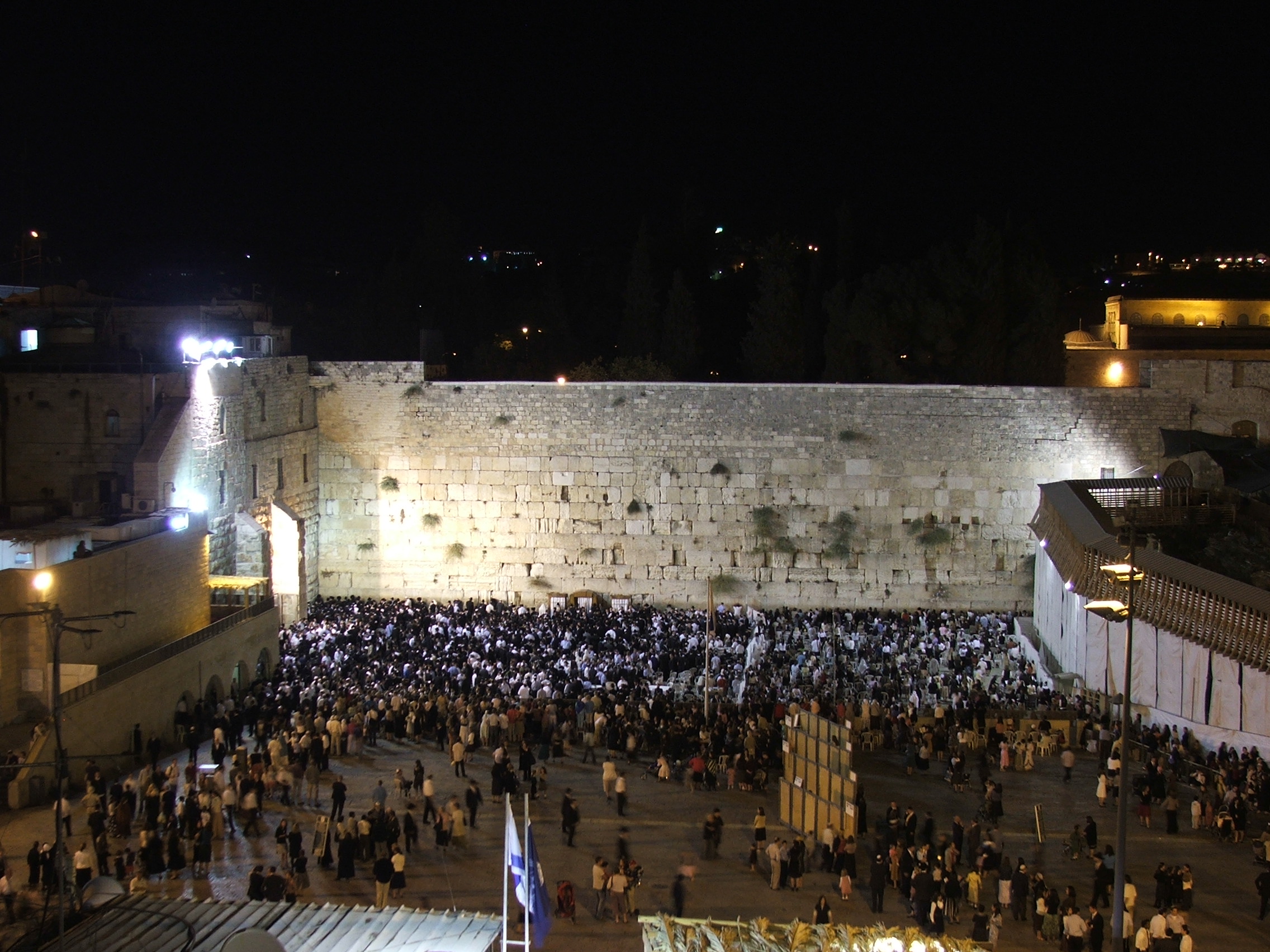
And then I ran to the Kotel.
I don't know why going to the Western Wall has occupied this spot in my life. The one thing I need to do in Israel, and the one thing I always try to squeeze into 3 minutes of time. Most of the time involves running to and from it -- just going through the Old City is a 20-minute trek each way -- even if, as I did, you cut through the Arab Shuk and coast along the stones and almost break your neck. And then you get there, and you throw yourself against the wall and say Shema, you say Psalms, you grab for any script you can, any arrangement of words that's already been written for you, because there's nothing you can say of your own that packs in quite enough pain and/or power. And you cry, without really knowing 100% why, maybe because you've built the experience up in your head or maybe you realize that all of the problems in your life, and all the incompleteness you feel, is all because you're waiting for the Messiah to come and heal it all and bring back your dead best friend and stop worrying about your kids quite so much.
Or maybe it's the Wall itself. The promise that hasn't been fulfilled yet, so it could be basically promising anything.
I finished praying. Ran back the long way, through the main streets of the Old City, hoping I'd bump into someone. Didn't. Grabbed a cab back, used my last 20 shekels, because I was late, and why would I change money when I could make a crazy zero-time dash to the Kotel instead?
I ended up returning to the party before the buses showed. Figured I had time to run to the makolet (translation: bodega, or, for you real English-speakers, a mini-mart) in the corner and grab some kosher Doritos for the family. Bumped into Matt Bar on the corner, who ran with me. He dashed into the store. While I swiveled on the front step, because this guy had just walked out and was in the process of bumping into me, and he was six and a half feet tall in a white shirt with tzitzis hanging on top of it and I had to pick my jaw up off the floor, because the last time I'd seen him had been on a movie screen, and he looked more like this:

He pulled me out to his car, which was tiny and black and old and totally awesome. It was a total fulfillment of his prophecy in Ushpizin
 , the movie he wrote & starred in, that even if he did get all that miracle money, he wouldn't spend it on something stupid like a fancy car. And his wife -- His wife! The all-time Adi Ran lip-synching champion of the world!* -- pulled out his new CD
 . Because he wanted to give me his address, and that was the most convenient way to write to him.
So now I've got an assignment. Remind me, please, if you get a chance. And, yes, by the time Matt and I got back, the buses still hadn't left. So we were safe.
_____
* -- you'll know what I'm talking about if you see the movie. So see it. Really.
Friday, July 2, 2010
Out of Office, But Still into You
Hey! So by the time you're reading this, I'm going to be far, far away, running to Israel for this odd Young Jewish Innovators convention. If you miss talking to me, TeensReadToo just posted a pretty lengthy interview with me about Losers
You have the chance to go back and change a scene from one of your previous releases. What book would you choose, what scene would you change, and how would you alter it?
There's one scene in LOSERS about a girl Jupiter likes, and how they both wind up in a very random and very suddenly emotional place, and he winds up discovering her eating disorder...and then something big happens. I totally understand why we took it out -- it was too much of an unexpected turn in the book, and it didn't really fit with everything else that was happening to Jupiter -- but I still think it's a great scene, and it still fits into the Jupiter chronology. It's been getting under my skin, how a 14-year-old guy deals with dating someone who has an eating disorder, and I think it might be growing into its own book.
keep reading >
Thursday, June 24, 2010
Nirvana's "Polly" Live (the cover version)
The slammin' Melissa Broder hosts the Polestar Poetry series, and she just tried something new*: picking an album (in this case Nirvana's Nevermind
I got in early, which meant that I got one of the first picks. I chose "Polly," the song about sexual assault and boys who think they control the world. Don't ask me why.
I didn't plan it this way, but the story I'm telling -- and especially Christian -- all ties in to my story in the anthology Punk Rock Saved My Ass
 , an incredible little collection to benefit 924 Gilman, one of the first punk collectives in Berkeley. It's only $10, and you should check it out. In order to get what I'm talking about in the video, though, check out the adrenaline-fueled piece Kat Georges did before me.
 And then go check out the whole series.
Wednesday, June 23, 2010
Punk Torah Prayerbook
On MyJewishLearning, I interview Patrick Aleph and Michael Sabani about the Punk Torah Siddur that they wrote designed, and released. My favorite part:
Some of the prayers — especially the bedtime shema — are surprisingly peaceful for, well, someone who shouts for a living. How’d you swing that?
Patrick: That’s fair. I’m in a band where I scream and roll around on the floor, but there’s a place for meditation in every person’s life. This is the best example I can give of this: I was at Jewlicious, and I was working in the kitchenwith Sasha Edge and her father, who catered it — they’re screaming and there’s knives everywhere, and fire. But then when it was time for Shabbos, we ended up making motzi over a vegan cookie and drinking Kedem grape juice and some of the back-of-the-house volunteers had a great, awesome, totally spiritual and peaceful moment. If you’re a rambunctious person like myself, it’s even more important.
read the rest >
Wednesday, June 16, 2010
The Rebbe and the Forty-Nine Hipsters
Last week, I told you how the Biala Rebbe was coming to our house. And I've gotten a bunch of emails/Facebooks/twittery questions back, asking the question that should be self-evident: What did he say?

First, let me tell you what I think. I think the Rebbe sees things that the rest of us don't see. I don't know if he's hooked up to any otherworldly powers or has a direct line to G*d that the rest of us don't. But I do think that he's a professional at this sort of thing. The same way that, more than a normal person, a psychologist is going to watch me chewing on my cuticle and know that it probably relates to the fact that I'm always hungry -- I mean, of course they will, it's their job -- the Rebbe also picks up on stuff. Maybe it's tiny physical movements. Maybe it's our auras. I don't know.
My wife and I sat down with the Rebbe. Immediately, before he asked our names (he always asks our names), he turned to her and said: "You're loved from above, and you're loved below. Why are you always stressing out?"
Case in point. It's not like other people aren't stressed. It's not like 98% of the people there weren't stressed. But, in her case -- this week, and the certain circumstances in our lives and what was going on -- yeah, it was pretty freaking relevant. If I would've had to pick a single topic to talk about, it would be the amount of stress that we (and, specifically, she) are under.
So, go fig.
It was a really weird night. Awesome, but weird. I'd kind of figured that it would be a party of sorts, since the Rebbe sees people one at a time and a bunch of us were waiting -- but it wasn't that kind of atmosphere at all. We sat around. We made small talk. It wasn't fun small talk, though; it was the kind of small talk that you make while you're waiting for the results of a particularly invasive exam. Everyone was half in that room and half in their own heads, thinking about what they wanted to say. When a random man with whom you have no straight connection flies from Israel, and you can talk to him about anything, it's a horrible kind of freedom. What's the most important thing in your life? How do you sum that up? What do you ask for a blessing for -- your kids, your job, your books? Everything?
In cases, like ours, you don't even decide. The Rebbe just starts talking. He spoke Hebrew, which I mostly understood, but it helped to have it repeated back in English (by Rabbi Davide, my old teacher at yeshiva) a second time. He asks the questions, and you fill in the blanks. He asked why I spread myself so thin -- to which I could only say, yes. I told him about my new movie and I asked what I should be writing now -- another screenplay, a teen novel, a real novel, or what. He said, it doesn't matter. Just pick something, and go on it 100%. Don't divide myself up.
I think we got lucky -- or unlucky, depending on your vantage point. We were the second people to speak to the Rebbe, so I had the entire rest of the night to chew on what he said. Meanwhile, people in the living room were looking at me for answers, like I'd gotten out of there successfully, so what do they do? The people on their way out didn't look at me like that. They had their own mental stuff going on.
Two Israeli girls who went in there came out satisfied, like they'd gotten the exact thing they asked for. My one stodgy, rationalist friend came out a little shaken, like the Rebbe'd pulled one of his Jedi mind-reading tricks. The person who was the most excited to go in came out crying. It sounds like a collection of riddles, or stories whose answers I'll never know, but in the moment, it was amazing -- like watching one of those grainy family videos that you shouldn't have a right to see, but you do. It really wasn't about fortunetelling. It was about what you boil your life down to, when you've only got one thing to say.
Halfway through our session, the doors to the room slid open. Rabbi Davide stood up, ready to intercept whoever was interrupting. Then my two-year-old daughter, who'd gone to sleep hours ago and who never woke up, ran in through the crack. She wasn't crying or afraid or uneasy. She just ran up, held her arms out, and demanded, "Up." I scooped her up, plopped her on my lap, and introduced her to the Rebbe, and introduced the Rebbe to her right back. Sometimes you don't even need a Hasidic sage to tell you what the most important parts of your life are. Sometimes you just need a conduit.
photos by Dan Sieradski
The Movie Gets a Little Realer
Just wanted to share two quick items of movie awesomeness with you:
1) "1/20" has an IMDB page! (No, I'm not on it yet. But my title is! Really, though, it has the movie's tagline and the actors and all sorts of official information that I didn't know anyone was allowed to know. But the big thrill is that, dude, it's the Internet Movie Database. It's the Hollywood equivalent of seeing your name in print for the first time.)
2)And we also have a movie poster:

That mohawk in the poster belongs to Xiomara, the star of the show. The director, the producer, and I were eating hummus on Ninth Avenue and this bubbly, cute, sane-looking girl strolled by. She was wearing a pink dress. Our producer leaped up and chased her down half a block, then dragged her back by one of her ponytails (she had two). "This is Ayako," he told us. "She's auditioning for Xiomara."
I didn't believe him. Then I saw her audition tape -- it was one of those tapes that you think might have been filmed at an asylum, where one minute she's sweet and docile and courteous, the next she's ranting and screaming and about to knock the camera out of the cameraman's hand -- and I was like, okay, this is working. Then she showed up for her haircut on the first day of filming -- I ran into her the next day in the dressing rooms, all spikes and leather jackets and hair that looked like it could pierce skin -- and she blew my mind. She wasn't that bubbly Ninth Avenue girl anymore. She was Xi.
Monday, June 14, 2010
Ethan Young and me fight over comics
Ethan Young, who does the fabulous online comic Tails, asked me to fill in for a while as he reaches the end of his first book. It's hard following a comic with a bunch of straight-up words, but we're talking about our comics obsession, so maybe that will help. Also, I ended up being a character in his comic, which (hopefully) lends my entries some DVD actors'-commentary credibility...

Anyway, go read it.
Maybe I’ve just been spoiled. Reading comics — especially reading someone like Neil Gaiman, or Alan Moore, who spend hours detailing the minutiae of how each panel looks. Yes, just mentioning their names is a cliché, but it’s obvious that they were both the kind of kids who read each page of a comic a hundred times as kids. They really appreciate the graphic design of a page; you can go over the panels and margins of, say, ‘League of Extraordinary Gentlemen’ and find something new each time.
That’s what I want my books to be like. The ones I write, the ones I read, the ones I buy. I know my prose-books won’t get that way until I start self-publishing, or until I get really big — Scholastic doesn’t let their mid-range authors anywhere NEAR the design computers — but a boy can dream.
And, in the meantime, I’ve still got my comics to read. And my omnibus Sandman to obsess over.
more >
Thursday, June 10, 2010
Best Email Correspondence in My Inbox, Hands-Down
show details 3:47 PM (52 minutes ago) |
jmoyjnlpymoytqtyyuyuiuewuuuyÿh
show details 4:10 PM (28 minutes ago) |
***
(I promise I won't be this cheesy all the time. Really.)
Monday, June 7, 2010
Meeting the Rebbe
Tomorrow night, we'll be hosting the Biala Rebbe of Jerusalem, Rabbi Avraham Yerachmiel Rabinowicz, in our house. Some of our friends, and a bunch of random people we don't know, will come over and ask the Rebbe a bunch of questions about basically anything.
It's pretty random. Or, if you see it that way, it isn't random at all -- in that mystical hippie-like way, or that Rebbe-like way, that everything on Earth that happens is connected.
I first met the Rebbe when I was in yeshiva in Israel. One of our rabbis started taking up the habit of hanging out at the Rebbe's synagogue each week during his visiting hours, every Wednesday and Thursday nights from 10 or 11 P.M. until 3:00 or 4:00 in the morning. I don't know what he said in order to get us to come, but one night, we tagged along. There was a bunch of us. One, Dan, was actually his first cousin -- separated by marriage and cultures and languages, since the Rebbe only speaks Hebrew and Yiddish.
Our appointment was scheduled for 10:30. Of course, this was Israel, where time runs differently than it does in the rest of the world. Also, just sitting in the synagogue was kind of like sitting in a hospital lobby in reverse -- that is, instead of seeing all sorts of people in various modes of depression and despair, you're seeing all sorts of people in various modes of despair and joy. People asking for blessings to have children, to meet their One True Love, to succeed in business, to find out what the hell they're doing with their lives.
Mostly, if you couldn't guess, I was in that last category, although at times, over my year in Israel, I fit into almost all of the other categories. (Almost. That having-kids thing was still way over my head, at that point.) I wasn't sure about anything. Whether I'd gotten married (which I had a few months ago) for valid reasons, or just because we were Orthodox and we both figured we had to. Whether I should be in yeshiva or trying to get more writer gigs. Whether writing my memoir about struggling with dating girls and being Orthodox, which I'd sold to a publisher just before I left for Israel, was a bad idea, or whether it was going to help other people with the same issues.
I never felt like I shouldn't be saying any of this, talking to the Rebbe about hooking up with girls and wanting to be friends with girls or missing my best friend, who'd just died. Weird, yes. Awkward, no. I just sat down, let my bad Hebrew fly, and with it all of the stuff I'd been holding in when I spoke to other people. Even my best friend. We were too much a part of each other's lives. This strange, quirky man with the massive beard and the wise smile on the other side of the table, I felt like I could say anything. We didn't have any of the same friends. We never ran into each other on the street. We didn't even speak the same default language -- and for me, when I said something in Hebrew, it didn't feel like I was saying actual words. Instead, it felt like a dream, a foggy half-reality where you have memories but you aren't totally sure what you're saying until it's already been said.
So tomorrow night we're hosting him in our house. We wanted to cook him dinner, but he doesn't eat these days -- he just drinks raw juices. Good thing we have a juicer. Itta ran to the store today and stocked up on some extra carrots and apples. That part, at least, we know what to expect. What goes into the Rebbe's mouth, we'll be prepared for. What comes out of it when we ask our questions -- that'll be a whole different story.

Friday, June 4, 2010
Almost a Restaurant Review
There's a new kosher restaurant right near our office. It's called Tiberias. The food looks yummy and the decor looks great and, rarest of all for a kosher restaurant (or, as I'm given to understand through reading way too many Anthony Bourdain books, rare for the restaurant business in general), the owners are actually perched by the door, welcoming people, and happy for you to be there. Oh, and hey -- they're giving out free coffee.
And yet, I'm not there.
Let me start from the beginning: Last night, I made the Best Sandwich Ever. (I know because I Twittered about it and everyone else on Twitter agreed.) 
So here I am, at work, starving, and the day is close to half over. I weigh my choices with all the usual overanalysis -- can it be vegan, or do I need protein? how cheap is cheap enough? when's the last time i ate pizza? -- and decide to hit the local kosher Dunkin' Donuts for a bagel.
And, on the way, I stumble into Tiberias.
At first I don't even know what's going on. All I see is two grinning guys out front, kissing hands and shaking babies and looking like they just won the lottery. One of them stops me -- the owner, it turns out. Today's the first day of business. He's super excited to be there. There is, he mentions several times, free iced coffee.
But the reason I stopped drinking iced coffee is the same reason my brain is working overtime: because I have an anxiety disorder, and I think too much, and caffeine only exacerbates it.
I'm peeking in the counters, and there are actually vegetables (another kosher restaurant rarity) and they look beautiful -- the eggplant sliced thick and juicy; corn as yellow as a field of radioactive flowers; perfectly grilled zucchini and red peppers. The menu in my hand lists the prices, and there's nothing less than $6.95. Except for soup, but I'm talking real stomach-filling food. The real meal meals are closer to $15.
I do the lunchtime math in my head. Packing my own sandwich costs $2 or so. Buying pizza, which is filling but not healthy, is $5 or $6. For another dollar or two, I could eat here, except that that's 20% of a meal, which is to say, I could eat out 5 times at a junky restaurant for every 4 times that I eat at this place. Or I could just pack lunch, save all that money, and spend it on my kids instead. Or save it for our trip to Australia. Or that subscription to McSweeneys that I really want.
But, really, is all this worth arguing about (or doing math over)? Kosher food, as Tamar says, is expensive. Kosher food in Midtown is expensive squared. We pay for convenience, and that convenience is multiplied when you're Jewish -- you're not merely paying for the food to be made for you, you're paying for someone else to pick out your vegetables and look for the kosher markings on the hummus carton and the bagels you would otherwise be checking out yourself. Elie Kaunfer wrote a couple months ago that most Jews don't know how to make their own matzah, and that's true, but that's just the tip of the iceberg -- there is no Jewish working class. There are upper-class people who can pay $20 for lunch, and there's this scraping-the-barrel class that packs our own lunch...or forgets to.
I do the Walk of Shame. I shuffle my feet the three storefronts down, to the donut store. I order a bagel.
The woman beside me turns around and checks out my yarmulke so deliberately that she's either making sure I'm Jewish or sizing me up for her niece. "You know," she remarks casually, "there's a new kosher restaurant that just opened up down the street. They're serving free iced coffee and it looks really good."
My face goes from zero to blushing. "I know," I manage to stammer. "I'm going to check it out when...when I'm eating lunch for real."
"I'm sorry," she gasps, seeing that she's offended me, but not knowing why. Meanwhile, I gaze at the intrepid worker who's currently toasting my bagel, enabling me to make it to 5:00 today...and wondering whether I shouldn't be toasting my own bagels instead.
Friday, May 28, 2010
The Orthodox Jersey Shore
When Frum Satire showed me In Over Our Heads -- billed as "the first unscripted Jewish reality television series" -- my knee-jerk reaction was, is it good for Orthodox Jews? The first episode followed women on a trip to the mikveh, a bath used for, uh, spiritual cleanliness (or, "ending the period of not having sex and transitioning into having sex," as one character puts it).
The second episode is less abrasively sex-centric, but manages to be even more sexual: Our heroes leave their religious community for the night, go into the city, and stay up all night at a dance club.
The verdict's still out. When new, odd Orthodox articles or stories or videos come out, I get a surge of overprotectiveness, because if you're Orthodox, every non-Orthodox person you meet over the next month will make all sorts of sweeping generalizations that your life is exactly like the thing they saw on YouTube. (If you think I'm exaggerating, I'm not -- you won't believe how many people asked me which Hasidic folk song Lady Gaga stole the hook to "Bad Romance" from.)
The show has its stronger and weaker moments. I'd be the last person to argue that dancing isn't a form of spirituality, but I cringe watching one Orthodox character struggle to defend her spiritual practice, eyelids fluttering from being up all night while scarfing down coffee, while sitting next to some non-Orthodox guy who keeps cutting her off and cursing at her. "A lot of people are afraid of what's inside them and don't express it," she says. "But if you express it, then you're free." On the other hand, it's flippin' reality TV. Of course these people aren't at their most coherent state.
The series has some moments of blinding clarity, and they've picked strong, smart, and likeable characters. We want to know these people. In some way, we do know them. Not just those of us who have friends, family, or who've even been those kids sneaking out at night from Monsey to the city, but for all of us who've been different.
I think I will keep watching In Over Our Heads, even if I'm not totally with it yet. It feels like we're watching a rehearsal for something. I'm not sure what it is yet -- they might not know either, either the producers or the stars -- but I'm excited to see it when it happens.
Wednesday, May 26, 2010
Paul Auster at Book Expo America
Paul Auster was at the book conference today, signing his newest novel, Sunset Park

I asked if he was overloaded with books or if I could give him a copy of my book Candy in Action, which Soft Skull had just passed off to me. He said a pretty clear "overloaded," until his (handler? agent? mysterious female companion?) smiled graciously and said "I'll make sure he actually reads it" and slipped it from my hands. Then we talked about the comic he'd written that I'd read to my daughter the other day -- he cackled when he heard that. "She didn't get it at all, did she," he cackled. I said she understood it pretty well, but she was still checking for an invisible man behind her.
He said he didn't like the illustrations; I thought they were good, but strange, like smelling one thing and tasting another. Then he moved on. But it was pretty cool.
A minute later on the other side of the expo center, I ran into the Jewish Book Council crew. I was still bubbly about my new Auster book. Carolyn hooked into my arm: "Take us there," she commanded. I did. I stayed low because I'd had my moment and didn't want to spoil it, but I saw he still had my book sitting there. Naomi managed to snap a picture of Mr. Auster and my book, and there it sits above us in this post. If *ahem* when somebody makes it into a movie, I sincerely hope they cast Paul Auster as the shady character who gives Candy her missions. And that they pay him a million dollars to do it. I mean, it probably won't be as good as Smoke, but it will be a whole other kind of good. Unless they get Tom Waits to record the music too. Then it might be.
My new favorite photo ever from the Jewish Book Council blog, courtesy of Naomi and co. Thank you thank you.
Friday, May 21, 2010
What's Held Me Up This Time
Sorry for the lack of updateage! But I've got what might be the best reason ever:

She was a big one, and (no surprise for a descendent of an author) was 17 days late. But she got here, and that's all we have to say about that. Her mother is recovering, and our midwife, despite being temporarily outlawed in the state of New York, is a pretty kickass deliverer. And, hey, the packages she shows up with are pretty damn great.
Thank you, all of you in Internet land, thank you immeasurably for your kind words and shout-outs and mazel tovs. Especially the non-Jews who don't know what mazel tov really means but say it anyway. Sorry I haven't been able to reply to each of them in kind, but please know that my heart is swelling like one of those water balloons that you've filled so perfectly that it ends up exploding in your hand.
**
The Forward just published an article I wrote about the Shondes, a violin-based punk band, which they just wrote very nicely to say that it's one of their favorite write-ups of themselves. So, there, you don't have to take my word for it.
**
My partner in musical crime, Mista Cookie Jar, will be touring the East Coast next month. I'll be doing the New York shows with him, and doing some of our Chibi Vision songs as well. We have a morning gig for kids and parents at Perch in Park Slope. He wants to book a nighttime club show, too, although he hasn't yet found a place. If you have any ideas, please give him a shout at his website. Tour poster coming soon -- oh, and soon I'm going to post a certain movie poster that I'm finally allowed to show you.
Big things coming up. Little things, too. But all of them worth dancing about, I do assure you.
Tuesday, May 11, 2010
From Another Planet
My new short story "Hailing Frequency" was just published (and you can hear or read the whole thing online). It's a story about an unemployed geeky dude who moved to Chicago for his girlfriend's job, and then the entire planet got invaded by aliens, and everyone's trying to live life normally, only he doesn't have a life to live yet -- and, yep, it's science fiction.*
It also doesn't have anything to do with Jews.
In this world where Jewish books are valued at a premium and branding books as "Jewish" can make or break a book, advertising your novel or short story or whatever as a Jewish book is pretty valuable. On the other hand, I just finished reading Joseph Kaufman's The Legend of Cosmo and the Archangel, which is written by a self-proclaimed "ultra-Orthodox Jew" and his Judaism is only secondary or tertiary to the book, behind his being a recovering hippie or a rural New Englander.
(On the other hand, a lot of people think my sidecurls look like antennae, which is a pretty good argument for me writing about aliens.)
There's a huge debate going on in the science fiction world about the split between more literary offerings and more, well, sciencey stories. (For a more in-depth explanation, check out this well-voiced article from the SF periodical Clarkesworld.) Does the television show Lost count as science fiction because there are shady explanations of time travel and otherworldly (or other-reality-ly) dealings? Or does it not, because the focus of the show is on the characters?
I'd submit that it doesn't really matter. Rebbe Nachman of Breslov's most popular book, Rebbe Nachman's Stories, is all about beggars and princesses and long walks through dangerous realms -- and virtually no one in the stories is identified as a Jew. (Keep in mind that Rebbe Nachman is one of the original Hasidic masters, not just some Orthodox dude writing fiction on his Twitter account.) Science fiction doesn't need to take place on Mars or in the year 2012, and Jewish books, well, don't need to have JEW printed across the top. (And, conversely, every book with the word "JEW" printed across the top isn't necessarily Jewish. Or good. But that's beside the point.)
Next up on my reading plate is The Apex Book of World Science Fiction -- edited, by the way, by the Israeli writer Lavie Tidhar. I'm kind of in love with it already (okay, it's an anthology, and I've been peeking). My favorite stories are the ones where nothing really matters except the vital parts of the story -- where the characters are like feelings, the setting isn't "Rome" or "Burkina Faso" but is instead a dry swamp, or a child's bedroom. The power of telling a horror story lies in its universality, and the power of an emotional story like Lost is the same -- no matter who you are, and no matter where you're coming from, a good story should be good to you. It should touch you. It should change your life. No matter how Jewish, or SFfy, it is.
____________
* - I'm saying "science fiction" instead of the preferred appellation "speculative fiction," because no one on this website knows what spec-fic means. Sorry, geeks.

Thursday, May 6, 2010
Sports Kippah
Like we told you before, real Jews wear hats. Don't wear a hat? Then you're not a real Jew. Unless, of course, you wear a doily, in which case you're the Jewiest Jew of all.
But, you might ask, what if I don't like wearing a kippah? What if I think they're too showy? Or too holier-than-though? Or all of mine are in the wash? What if -- you may thunder, evoking a wrath like the first time G-d saw the Golden Calf -- I care about global warming and the ozone layer and cancer and all that stuff, and I want to keep the sun out of my eyes? What if I play sports? What if I'm an outfielder in baseball and I need to block the sun out of my eyes to call out someone? What are you trying to say, Roth -- that real Jews don't play sports?
Whoa, there, imaginary person -- calm down. People like you are the reason that the YamuKap was invented.

Now, one of my friends called it "the most hideous article of Jewish clothing ever invented." And that person does have a point -- it's not like a yarmulke has a special power that an average everyday hat, doily, or towel thrown over one's head can't replace. But I do have to admit, there's something beautiful if inelegant about wearing a Yamukap -- a yarmulke is supposed to keep you mindful of God, and I don't think I could forget for a second that I was wearing this thing, if I was wearing it.
Which I'm not. Because I'm a geek and a tech and a writer. I use the internet, learn Talmud with Rashi, and I never go outside. But that doesn't mean you shouldn't. And for that, you'll always have the Yamukap.
Thanks to Aaron Roller of Mimaamakim for this one. You're a prince.
Wednesday, May 5, 2010
Gay Jewish Cats (who like my books)
The relentlessly cute band Stereo Sinai just sent over this picture.

In their words:
"The attached photo is of George, our gay cat, sitting on our coffee table by your zines and Goldie's book, extremely happy. The only other time he sits like that is when he's near shoes. He has excellent taste. You should be proud."
I'm glad. I love my zines, but I've always worried that they weren't as cuddly as the real-bound books. "Goldie's book" means Goldie Goldbloom, who also lives in Chicago, whose first novel was just released, and is also awesome. And it's weird -- it definitely didn't happen as fast as the pop-up taqwacore movement, but I do believe we're starting a movement.
Tuesday, May 4, 2010
Give Her a Get
Jewish punk music might have ditched the kitsch for good. While I love myself some YIDcore, the silly Australian punk band, the Groggers' new music video for the song "Get" is everything that punk is supposed to be about -- mostly, positive social change and making you uncomfortable.
I have no idea whether they're disgruntled yeshiva boys or sardonically clever baal teshuvas or another monster entirely. Dear Groggers, who are you? Do you have more songs? And are you actually cool in real life? Give me a shout.
And, if you want to know more about what a get is or exactly why it's permissible in Jewish law to kick that dude's tuchus six ways to Sunday, read MyJewishLearning.com's article on agunot get, and check out this other swanky example of art-as-activism: a comic called the Unmasked Project.
(And thanks to the innumerable Heshy Fried for showing me this.)